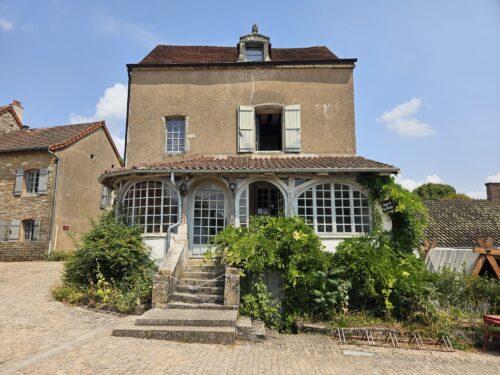
 Here’s what I read while I was camping in France. It was very hot. I may have melted a few times. It was way too hot for complicated stuff, so for unrelated reasons: here’s a picture of a hotel that’s for sale in the charming, medieval town of Brancion in the Bourgogne for anyone contemplating a career change. Say hi to the former caretaker’s wife; she was very friendly.
Anyway, here’s what I read.
A Short Stay in Hell (Stephen L. Peck) ****
A man, a devout Mormon in life, wakes up in Hell. A demon explains that he will be roaming the hallways of a massive library that has his life story in a single book; his mission is to find it. At first, he is hopeful, but eventually the sheer infinity of the project begins to weigh on him.
I quite liked this one. The story isn’t entirely original (the concept was lifted from an Jorge Luis Borges short story). It’s certainly better than that other book about libraries after death, The Midnight Library; if you liked that one then this is probably not for you. It’s a lot more acerbic and depressing. That makes the horror more effective: rather than having scary monsters jump out of the closet, it’s watching the sheer desperation set in that does the trick.
System Collapse (Murderbot #7, Martha Wells) ***
Murderbot is still on the planet on which we last saw him. It’s still not entirely itself, but representatives of the Barish-Estranza corporation have come to the planet to convince a group of settlers to sign their rights away as indentured servants. Murderbot and its humans try to not make it happen.
It’s more of the same: it’s fun, though it took me a while to get into it. My issue with these books isn’t that they’re not entertaining – they are, even if the descriptions that Wells gives us are frequently confusing – but that they’re kind of all the same. I did enjoy watching Murderbot move away bit by bit from the bot and more towards being its one of a kind self. I hope it spends a bit more time bonding with its fellow liberated Sec Unit in the nextnovel.
Tough Guy (Rachel Reid) ***
Ryan Price is an enforcer: the type of hockey player sent to intimidate other players. He’s a big, hulking man with a bushy red beard and long, wild hair, which is why most people haven’t guessed that he’s actually rather timid, suffers from deep-rooted anxiety, and has been thinking about quitting hockey. Fabian Salah, on the other hand, is every bit himself: a colourful singer with an androgynous look and matching wardrobe. Fabian hates hockey: his family are big fans, and he has always felt that he didn’t belong. So when Ryan and Fabian meet, they don’t seem like a good fit, but, y’know, it’s a Gamechangers book so we all know where this is going.
It’s the last book of the series that I hadn’t read yet. I’d been putting it off because I didn’t like Fabian in the other books. He seemed to suffer from Sara Linton syndrome, where everyone in the book fawns over a character that just didn’t seem all that likable or interesting to me. I’m glad to say Fabian was more likable in this book. Ryan, meanwhile, is an absolute sweetheart, and I enjoyed the sex scenes more in this book than in most other books in the series (I don’t mind them, but they can be a bit repetitive). And as always, it’s a lot of fun seeing Shane and Ilya – particularly Ilya – pop up here and there. Still, I think this is one of those cases where the screen adaptation is better than the source material and of all the couples in the books, this is not my favourite.
Flesh (David Szalay) ***
Istvan is a young man growing up in a dour, barely post-communist Hungary. He is angry, restless, and his future is looking bleak until he manages to attract the attention of a wealthy, if somewhat dodgy, businessman in London who gives him a chance. Soon, he finds himself rubbing shoulders with the rich, only to lose it all again after a few catastrophic events.
I’m torn on this one. The writing is excellent, and Szalay is very good at portraying the depressing situation in which Istvan finds himself at times. It’s an easy read. Istvan isn’t always likable or smart, but that’s not a bad thing: we see the pitfalls coming, but it’s always easier to judge from the outside. What I didn’t like was that it relied on a few clichés and quick twists that I didn’t think really fit the story. I haven’t yet read the other novels shortlisted for the booker that year, but I wonder what they’re like and why this one won.
The Heir Affair (Heather Cocks and Jessica Morgan) **
Rebecca (Bex) Porter and her husband, Crown Prince Nicholas, have fled London after their disastrous wedding. They enjoy life in anonymity – beards, wigs and all – but eventually they do have to come back into the royal fold, particularly as pressure on Bex to make amends to public opinion mounts. And there are other expectations to be dealt with…
I wasn’t a huge fan of the first book of the two, The Royal We. It’s probably better than I remember – I’m a terrible snob and this was one of my first forays into the romance genre – but I mostly remember a lot of fretting and waffling, and I’m allergic to fretting (not to waffles, thankfully). I found that in this book as well, but where its predecessor at least had the fun of watching Bex and Nicholas grow closer, this one has a highly implausible plot about the Queen and baseball, of all things. I hated it. The waffling, too, is still there, and the angst – oh, the angst.
I feel like there was probably a good book in here, but It got a little drowned out by tone deaf details meant to be endearing and a great big stretch of handwringing. It definitely wasn’t for me.
And now I need a waffle.
Last One Out (Jane Harper) ***
Ask any thriller reader who you’ll want to read if you’re looking for something more literary and in-depth and chances are they’ll send you to Tana French. Jane Harper’s books are of the same cloth, though they are set in Australia rather than Ireland. In this one, a young man named Sam disappears on his twenty-fifth birthday. His footsteps are traced to the inside of three abandoned houses, but they never leave the building. Sam has vanished without a trace. Several years later, on the anniversary of his disappearance, his family come together for a memorial.
Harper is excellent at using Australia as a secondary, or even primary, character in her novels. From the treacherous coastline in The Survivors to the harsh conditons in the Outback in The Lost Man (and if you ever read any book of hers, pick that one). This is no exception: the charming town in which Sam grew up is slowly being taken over by a mining company pressing closer and closer to its edge, driving the residents away with noise and legal threats. The town is torn: do we stay and fight for our community, or do we give up, sell our house for a pittance, and leave? And as always, her characters are warm and loving and feel so real you can see them in your mind’s eye quite clearly.
I liked it, but it did take a long time for the plot to pick up. It wasn’t quite as engaging as her other novels.
But still, people – read Jane Harper. You won’t regret it.
