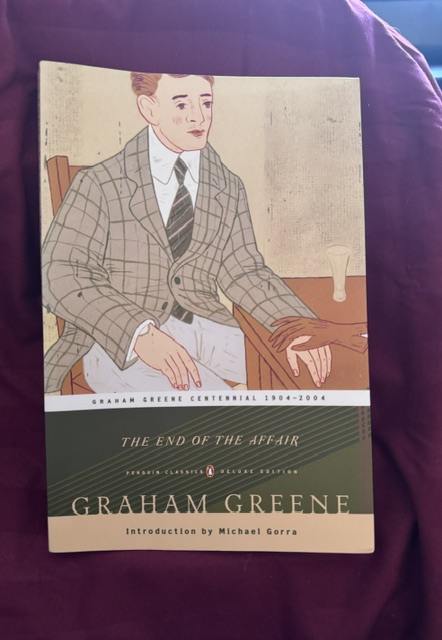
 Graham Greene’s The End of the Affair is a curious book. On the surface it is a recollection of the beginning and end of an adulterous affair, an all consuming passion that rocks back and forth between desire and hate. This is set against characters’ wrestling with the existence of God, making the story a rather religious treatise in some ways.
The narrator, Maurice Bendrix, takes the reader through his affair with a married woman named Sarah Wiles. Meeting at a dinner with Sarah’s husband Henry in attendance, they soon fall into a ravenous physical affair that turns to an equally ravenous, jealous love.
The story takes place after Sarah has ended the affair, but Maurice is tormented that he doesn’t know why. He suspects another lover, which taps his deep jealousy and turns his love into hate, although he returns again and again to his obsessive love. He is friends with Sarah’s husband Henry, a mild mannered civil servant whom Sarah has long ago stopped sleeping with. One day, Henry runs into Maurice and tells him that Sarah has been going out frequently and he suspects she is seeing another man. Despite his mild disposition, Henry is deeply in love with his wife, and is tormented by the thought of her betrayal. He proposes that Maurice, in his stead, hire a private investigator, but then backs off from that idea. Maurice decides to hire the P.I. himself, as he wants to know what Sarah is doing.
The P.I.’s man, Mr. Parkis, follows Sarah, and Maurice discovers she has been visiting a Richard Smythe. Shortly, Mr. Parkis finds his way into Henry and Sarah’s home and steals her diary. He gives the diary to Maurice, who discovers why Sarah left him and her passionate, abiding love for him even still.
Sarah recounts the night when Maurice and she were lying together in his bedroom, when a device of some kind explodes his building (this is during World War II). He is thrown across the hallway, where a door collapses on him. Beside herself with fear, Sarah–who is not religious and does not conceive of god–prays to god that if Maurice’s life is spared, she will end the adulterous affair. Maurice survives and though she is still uncertain if she believes in god, she keeps her promise.
Sarah goes on to write about the torture of wavering between non-belief and her increasing draw to the Catholic faith. One day she sees Richard Smythe in the square, who talks passionately to the crowd about atheism. He offers to meet with people one on one to talk about the issues, and Sarah starts seeing him in a student-teacher capacity.
Reading all this, Maurice is sent to the heights of happiness. Richard is not only not her lover, she remains deeply in love with Maurice. Indeed, neither of their obsessions have faded. They both have flip-flopped between love and hate of the other. Maurice muses that hate and love are intertwined, with hate emerging from love because of the pain their affair causes next to the joy. Maurice is firmly an atheist, and is frustrated by Sarah’s promise to god and what to him is an inexplicable struggle with a newly budding and intense belief. Knowing Sarah still loves him, he vows to get her to run away with him. But the story ends in tragedy, the last line of the book Maurice’s thought: “O God, You’ve done enough. You’ve robbed me of enough, I’m too tired and old to learn to love, leave me alone forever.”
It’s a little hard to understand the role belief (or not) in god plays in this book. It is everpresent, and passionately grappled with by various characters. It is tied up with the role love plays and its connection to something that feels higher. The book is frank about sex (though not graphic) and conveys the enormous role it plays in Sarah and Maurice’s love. Maurice and Sarah idealize each other, and it’s not until Maurice reads her diary that there is any sense that they know each other in a deeper way–what their character is and interests besides each other. The relationship Sarah has with god eventually consumes her, without losing her passion for Maurice. But god is a disruptive force, to all the characters in one way or another. It was a very good book but I will have to think more on its themes.
