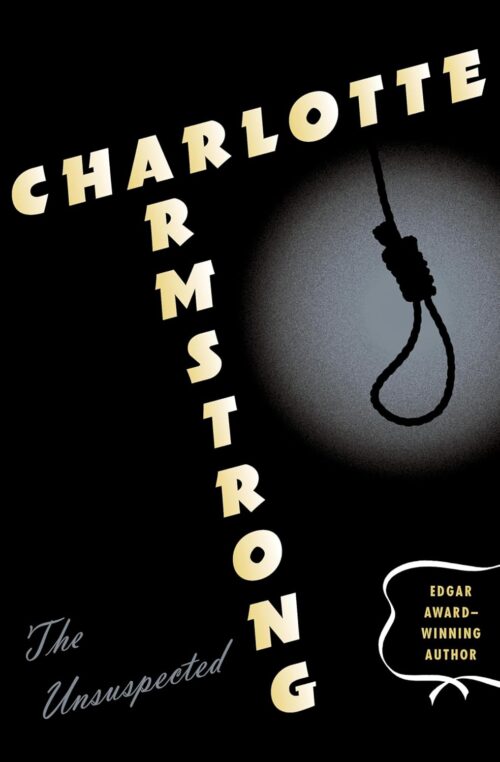
All I knew about this book before picking it up was that it had been adapted into a movie starring Claude Rains. I caught part of that movie on TCM one time and it looked intriguing so I thought I would check out the book. However, the novel is unfortunately really a very silly little thriller, reliant on extreme contrivances and characters behaving stupidly.
The setup is this: Francis and Jane are a nephew and aunt of about the same age who are mourning the loss of their relative Rosaleen, a private secretary who died by apparent suicide in the home of her wealthy employer. Not believing their cousin capable of taking her own life, they suspect her boss, Luther Grandison, a theater director turned popular radio host, of having killed her. Together they infiltrate the Grandison home to investigate. Jane has become Rosaleen’s replacement without informing Grandison of the family connection, while Francis has taken an extremely risky gamble, presenting himself as the husband of Grandison’s ward Mathilda, who has been missing for weeks after a shipwreck and is on the verge of being presumed dead. Francis’s gambit is further complicated when Mathilda turns out to be alive and well and on her way home.
I began to check out once Francis started trying to convince Mathilda that she had married him before leaving on her trip and had forgotten him due to the trauma of her near-death experience. My interest continued to wane as Mathilda seriously seemed to consider this possibility.
Nothing that happens after this has even a whiff of plausibility. Francis and Jane continue their investigation, another crime is committed for a very silly reason, and then Francis is imperiled and saved in a truly absurd manner, after Grandison becomes aware of his suspicions.
The issue is that Armstrong moves too briskly to really bother laying any groundwork for her outrageous scenarios. Grandison is a ruthless sociopath because the story needs him to be, with a handwave at the end to justify why such a successful man would be so hard up for money. Mathilda consistently acts incredibly stupidly, to the extent that it becomes impossible to maintain much sympathy for her even as her life is in danger.
This is a slapdash, ham-fisted example of the noir genre, a reminder of the “pulp” in pulp fiction.
