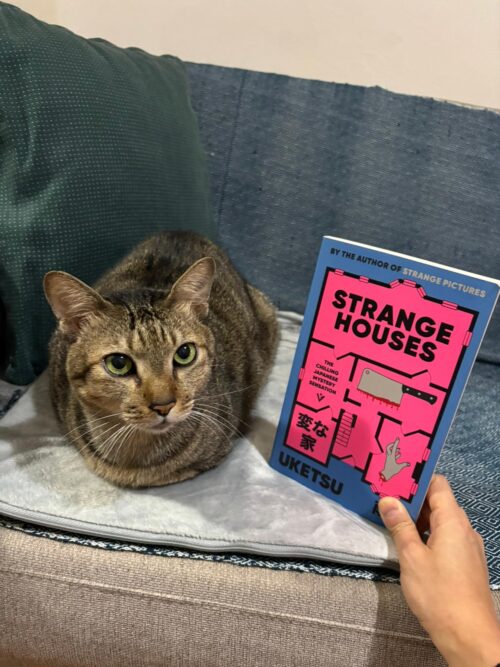
Strange Houses was the first book I read this year, back in January, and it has taken me entirely too long to just sit down and jot down my thoughts about it. Part of it is because I was very disappointed with how promising the premise was and how it fully deflated by the time I got to the end, so much so that now six months later, I’m honestly struggling to remember how it ended.
The other reason why it took so long is — well, you know, 2026. *gestures at everything*
I first heard of Strange Houses from a Cannonball review, and it thoroughly intrigued me. Told from the point of view of a Japanese columnist who writes about odd happenings, it kicks off when he is approached by a friend asking for advice on a house he and his wife were looking to purchase. His friend passes him a set of the house plans, asking him for his thoughts on it. At first glance, it seems pretty average, but something nags at him and the writer decides to take it further to an architect friend to ask him for his expert opinion.
The architect friend comes back and points out a “dead space” hidden between the walls on the ground floor of the two-storey home. What is that space for? And so this mystery tickles the narrator’s curiosity, which leads him down several paths of surprising discoveries — there’s an eerie hypothesis, family secrets, and ancient “traditions”.
In the end, I found Strange Houses to be a bit like the “short stories” so often turning up on my Twitter feed — it grabs you immediately thanks to its algorithmic writing, pushing you to click on the next tweet to find out more in the story. But when you come to the end of the thread, it’s rarely fully satisfying. Instead, the final tweet is usually abrupt — either tying things up too neatly or requesting a perfunctory “follow for more” — and you’re pulled out of the magic of storytelling.
That being said, I don’t regret reading this. I read this after months of apartment hunting, so poring over floor plans and ruminating how spaces could be used very much scratched that itch. Apparently, I’m a sucker for looking at apartments, horrors within the walls be damned. If this is an element you think you’d be into, I fully recommend buying the actual book so you can flip between the pages to check out the house plans as you’re reading.
It was also my first foray into this sort of fiction, the kind where I can see how it’s perfectly crafted just for our ADHD’d world. This mystery is for quick consumption — I finished it in two settings, and was pretty annoyed there wasn’t more to the ending — like having a Snickers bar in lieu of actual dinner. There’s nothing wrong with that. But these empty calories don’t really sate you; you’re often hungry for something else later.
