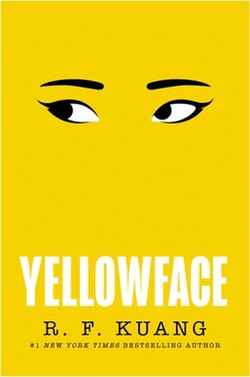
 I love an unreliable narrator. Whether they are divorced from reality à la Montresor of “The Cask of Amontillado,” deceiving themselves as a defense against trauma, like Pi in Life of Pi, or intentionally deceiving the reader, as in many mysteries I won’t name to avoid spoilers. . .I just can’t get enough of them. What intrigues me about June Hayward (aka Juniper Song) in Yellowface is I’m never certain how much of her own press she buys into. She definitely believes she’s been screwed over by an industry that doesn’t care what a bland, white girl has to say, but when it gets into her crimes of plagiarism, things are a bit fuzzier. She adamantly defends her actions, but part of me wonders how much she is truly deceiving herself.
To back up a bit, Yellowface is about two writers: Athena Liu, beautiful, “exotic,” and a darling of the industry; and June Hayward, a once-promising newcomer who hasn’t reached the level of success that was expected of her. When Athena dies suddenly on the night she and June are celebrating Athena’s new Netflix deal, June has the presence of mind (while waiting for the ambulance) to steal Athena’s latest manuscript, a novel about Chinese laborers during World War I. She revises the manuscript, titled The Last Front, and submits it as her own original work. The novel is an immediate sensation and June (who’s been rebranded by her new publisher as “Juniper Song” to signal a “fresh start”) is on top of the publishing world, at last.
In June’s mind, the novel is hers. She repeatedly tells herself that the manuscript she took was a rough draft, that it never would have been published in its current format, and in a blatant attempt at self-delusion, that without her, this very important story of Chinese history would never be told. The more defensive she becomes, the more she insists that her own contributions outweigh Athena’s. Yet, if we turn all the way back to page 14, when she first sees the manuscript, we’re reminded of the truth: “I can tell this book is going to dazzle. The writing is tight, assured . . . . Every description, every turn of phrase–it alls sings. It’s better than anything I could write, perhaps in a lifetime.”
Of course, wherever there’s a popular new novel, there are going to be critics that don’t like it, sometimes fairly and sometimes not. One critic who takes aim at The Last Front, writes “It joins novels like The Help and The Good Earth in a long line of what I dub historical exploitation novels: inauthentic stories that use troubled pasts as an entertaining set piece for white entertainment.” A random YouTuber attacks the novel for its cultural errors, which outrages June since Athena (the source of those cultural claims) was Chinese, but she can hardly use plagiarism as a defense.
June is the central villain of the novel, but she’s not a devil among saints. Reading between the lines, Athena was at best insufferable and at worst manipulative (for the record, what Athena does to June during their freshman year of college, which later helps June justify her own actions, was messed up, but it obviously wasn’t plagiarism). Hundreds of random social media users are eager to destroy June based on unfounded claims by an anonymous source. The characters in the publishing industry are self-serving and vindictive (I’m with June on this one–a publishing assistant posting an unsubstantiated 1-star review of their house’s latest novel is petty and unprofessional). By the end, it becomes apparent that June wasn’t the only one harboring jealousy toward Athena, with one character from publishing boldly stating, “We hated that bitch.”
I have to confess that, at times, I felt pity for June. Jealousy is a horrible emotion, a self-administered poison, and anyone who has ever felt a pang of envy toward an acquaintance–for their success, their money, their social life, their looks–knows how difficult it is to overcome that feeling and be truly happy for someone else. Add to that a family that shows no support or even interest in June’s career, and one can understand how she slid into desperation. That pity was generally tempered by June’s predictable return to casual racism, though, and above all, I could never forget how June, after watching an alleged friend (okay, “frenemy”) die in front of her, had the presence of mind to grab an unpublished manuscript on the way out the door.
Yellowface isn’t just about race and cultural appropriation in the publishing industry. It’s about that, certainly, but it’s also about the toxicity of social media, where users will send death threats to any given target based on zero evidence. It’s about how the publishing industry can select its stars and make or break an author based on who it decides to promote (that’s the unreliable narrator’s perspective, but one I’m inclined to give credence to). It’s about the ethical boundaries of using other people’s pain and experiences as fodder for storytelling. It’s about jealousy and self-doubt. In the author’s own words, it’s about “loneliness in a fiercely competitive industry.”
This is a compelling novel. The ending went in a direction I wasn’t expecting (June makes so many stupid decisions it frustrated me sometimes), and I’m not sure how I feel about the way it wrapped up, but overall I really enjoyed it. It’s a fast-paced read and a catalyst for questions about publishing, racism, and writing. I recommend reading on your own, or to make it even more fun, with a book club. Whether this novel delights or frustrates you, it’s bound to generate lots of interesting discussion.
