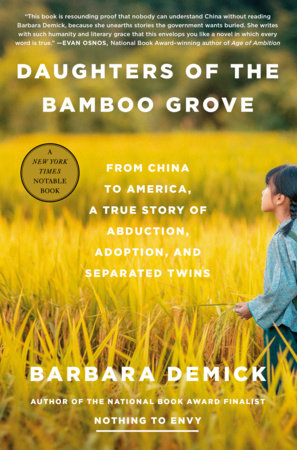
 Daughters of the Bamboo Grove (2025) by Barbara Demick is another book I first saw on NPR’s Favorite Books List. Then my husband read it, and he also recommended it to me. Demick is a journalist who was based in China for a number of years. She writes about China’s one-child policy, and how that affected children and families in China. Because of the draconian rules around having too many children, children were being abandoned in growing numbers, especially baby girls. In 1992, China allowed for international adoption and over 160,000 children were placed out of the country–most to the United States–over the next three decades.
Demick focuses on two twin girls, who were the third and fourth children of two rice farmers born in an isolated mountain town in China in 2000. The twin girls were Fangfang and Shuangjie. While the parents were in the city with Shuangjie making money to pay the fine for their children, Fangfang was brutally kidnapped from her aunt and uncle’s home where she had been staying. It is estimated that as many as ten percent of the children adopted out of China were forcibly taken from their parents or relatives.
So, Shuangjie grew up with her family in China with the shadow of the traumatic kidnapping of her twin sister. Fangfang was adopted to an older, religious couple in Texas who had already adopted one little girl from China. Both girls grew up in a loving family, but they had drastically different experiences. Through Demick’s reporting, she met Fangfang’s family in China, and thought she might try to figure out where Fangfang ended up for them. With a lot of luck, Demick discovered Fangfang’s likely location, but when she reached out to the family, they were not interested. Fangfang–now Esther–was only nine years old and her adopted father had just died. Demick told Fangfang’s Chinese family that their daughter was safe in America, but left it alone after that.
Many years later when the girls are seventeen, Esther decides that she wants to know more about her birth family, and they get in touch with Demick again to help them. Demick facilitates some Facetime calls and then finally a meeting in China with the two families.
This book was fascinating. I was aware of the one-child policy in China, but I knew almost no specifics and had never thought critically of what it would entail. The breadth of the Family Planning Association, how many people were involved, and their powers over people’s bodies and lives was shocking to read about. The kidnapping of children to sell them to orphanages was brazen and astonishing.
I was impressed by Demick’s ability to explain complex policies in a huge country without getting bogged down in too many details. I also like that the book starts out in China, from the point of view of the birth parents. It gave me a better understanding of the people in China and the tragedies they faced through the one-child policy. In addition, I was impressed by how much compassion she had for everyone involved. She really focused on the people and their love for their children.
Demick also discusses orphans, specifically Chinese and Korean orphans raised in the United States. When Esther came to China, she finally looked like everyone around her, but she was also an American foreigner.
I found this book hard to put down, and I feel like I learned a lot. Highly recommended.
You can find all my reviews on my blog.
