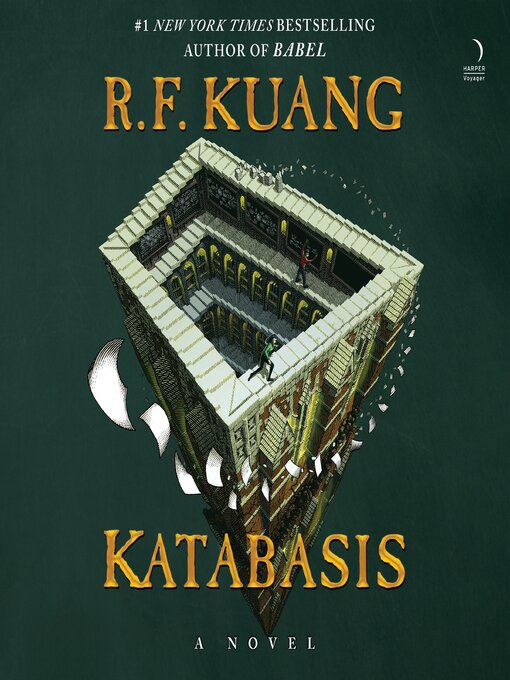
Katabasis, noun, Ancient Greek:
The story of a hero’s descent to the underworld
Alice Law has but one goal: to become one of the greatest in the field of Magick; to make all the sacrifices (her pride, her health, her love life, her self-respect, and most of all her sanity) worthwhile. All to work with Professor Jacob Grimes at Cambridge, the greatest magician in the world. (And one of the worst humans; but what does a vicious personality and a tendency to drive others to suicide matter in the great scheme of life? Genius is genius. It is no surprise that this is said about a man.)
That is, until he dies in a magical accident that could possibly be her fault. Or someone else’s; details are fuzzy. All that is important is that Jacob Grimes is dead, and with him quite possibly Alice’s academic future.
So Alice has to go to Hell to get him back. No big deal, she’s a genius in Magick. Even if her rival, Peter Murdoch, has the same ambitions, and the same plan.
With nothing but the tales of Orpheus and Dante (and a host of other readings) to guide them, enough chalk to draw the Pentagrams necessary for their spells, and the burning desire to make all the academic trauma mean anything, they set off across Hell to save a man they don’t even like.
But Hell is not like anything their research said it would be, and there are far worse things than Academic failure ahead of them. Now forced to rely on each other, will the secrets in Alice’s and Peter’s pasts bring them together, or drive them apart?
As with the rest of R.F. Kuang’s books I’ve read so far, I’m not 100% sure what I thought of this. She has a habit of writing incredibly unlikable/self-pitying/constantly angry/never to blame for their own failings/in a fanatical desperate for their approval yet loathing them relationship with their mentors kind of people as her protagonists. And yes, I know they come across very much like actual people you would meet on the street, but they are still just so unlikable.
I also wonder what other than the bragging rights about a famous Alum Oxford and Cambridge are getting out of Kuang’s books, because she sure seems to love tearing into them with vicious sarcasm and derision. I know her point in this book is “the true Hell is Academia”, but if her books are to be believed that’s her opinion in day-to-day life as well. Or at the least, she’s pointing out that both Cambridge and Oxford, in her opinion, are not really welcoming to students of Asian descent. But there is real vitriol both here and in Babel.
Some downsides. The “evil” that appears in Hell that torments Alice and Peter I don’t understand why it’s there other than to add another plot element, maybe hold a mirror up to Alice and Peter to show them what they have the potential to turn into, and to take Peter out of commission for a chunk of the book. They cause some of the biggest high stakes/low stakes big overture, little show I’ve read in a while. The solution to them is just, “Really? That’s how it ends?”
Alice being the stereotypical “I’m not a feminist, feminists are crazy lesbians whinging about nonsense. I’ll show the guys I’m cool by being sexy without being slutty, smart without being overbearing, capable without being egotistical, and then they’ll like me” woman in Academia was grating. “If I have seen further it is by standing on the shoulders of Giants” is not just Isaac Newton about Scientific Progress, Alice; it’s about the rights you’re taking for granted. And then when the system behaves exactly like the system would in 1970’s Academia, and the response is as to be expected, Alice goes into Surprise Pikachu face when she gets smacked between the eyes.
 (This woman has a monologue that Alice apparently never heard.)
And the ending? When someone’s lack of caring (or conversely, lack of being more godlike but still indifferent), causes a split-second decision the likes of which I haven’t seen since Dragonball Z with Vegeta and Nappa going to Earth or not.
There are good points to balance all the not so good. The description of Hell is fascinating; I especially loved her take that every story written of Hell is true, and the geography just changes to suit each person. (I love the fact that Alice and Peter’s Hell starts out being an inverse of Cambridge.) Also, that there is just one God of Death that will happily assume the form you’re most comfortable seeing them as. Elspeth, a character Alice and Peter meet along the way, is someone I enjoyed and wanted more of. And Archimedes, the Campus cat, is like all cats, perfect. Glad to see Kuang follows the popular belief that cats can just go in and out of Hell with ease.
There are unanswered questions: does Alice keep her bone armor? Is she now a feminist? Why did the fact that two research assistants finding Alice and Peter’s pentagram go absolutely nowhere? If the Poppy War trilogy has a romance in it, is it as half-baked and awkwardly written as the one here? Should I buy a replacement copy, as I am one of the people who bought the Limited Edition and discovered a printer’s error in the middle of reading, and had to go on Reddit to squint at a page to see what I missed?
But there is one answered: will I read the Poppy War trilogy and her upcoming book? Probably. If for nothing else, to see if she finally writes a book I wholeheartedly enjoy.
