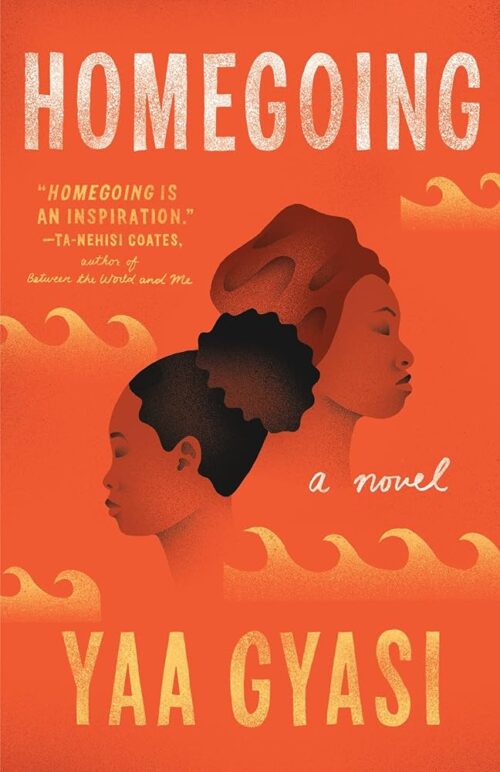
Many Cannonballers have already reviewed Homegoing, and I doubt I’m going to add any profound insights with my own review. Long story short, I thought this book was amazing. I wish I’d read it much sooner.
Homegoing is a family saga, starting with two half-sisters, Effia and Esi, in 18th-century Ghana who don’t know the other exists. Each chapter alternates between their descendants. Effia is married off to a white man from England and lives a fairly luxurious life in a fort, while unbeknownst to her, her half-sister Esi is captured and being held in the dungeons below the fort, before being sent to the U.S. as a slave. After devoting a chapter to each sister, Yaa Gyasi then alternates between their descendants for the rest of the book, one chapter per character for 7 generations. Effia’s descendants stay in Ghana, for the most part, while Esi’s are in the U.S.
As you might expect from a book dealing with slavery, this book is disturbing and sad. It sort of feels like a series of short stories rather than a novel, since each chapter is about a different descendant, capturing a particular turning point in their life. Some end on a hopeful note, while others most certainly do not. Gyasi very skillfully gets the reader to care about each character, even though we know we’ll only be with them a short time, and for the most part each one feels fully realized. There were a couple characters I didn’t feel as invested in, or didn’t understand as well, but at the end of most chapters I felt a little sad to realize my time with that character had come to an end. It’s hard to pick a character or chapter that will stay with me the longest, but I was particularly attached to Kojo, who escaped slavery as a child and lived in Baltimore with his family when the Fugitive Slave Act is passed. His story is one of the more harrowing. In the end, I felt attached to ALL the characters and was tempted to restart the book as soon as I’d finished it so I could spend more time with them.
I think even someone who knows a lot about the history of the slave trade and its generational reverberations would learn something new from this book. I know I learned a lot. It’s an ambitious book, for sure, but I thought it was wonderful.
