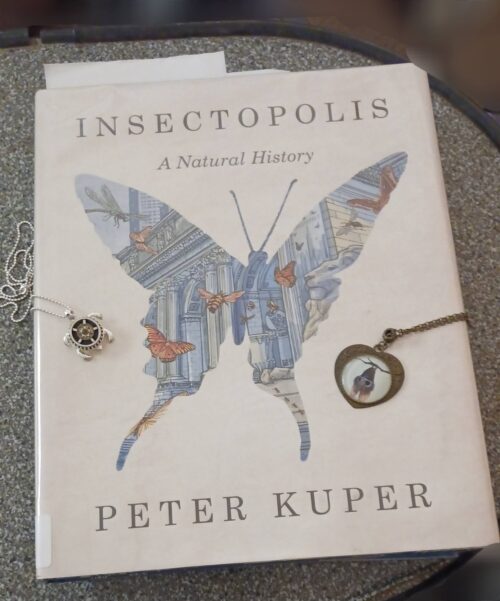
 Insectopolis: A Natural History by Peter Kuper is a crazy, wild, odd, neat, and informative read. I have read books on insects (mostly picture books and graphic novels for children to teens), but I think this might be my favorite read yet. Kuper mixes fiction, fantasy, speculative and non-fiction as the impact of these creatures unfolds.
We start with a brother and sister off in New York City, going to an exhibit at “some library.” The sister is a scientist, her brother a “dude” but he obviously loves his sister, though doesn’t understand her passion for insects. We then have an emergency warning, a few weeks later we have a scene, several months later the subjects of the exhibit find themselves exploring their brothers, sisters, cousins, and other creatures within the insect families.
From food to wars to diseases, insects have worked their way into our lives. We explore the myths, the truths, the people and places. We see how dung beetles get a mate or how a tiny “seed” on a cactus found itself being one of the most expensive and sought after colors in the world. Insects have shaped and seen the world as humans walked through it. Of course, they were here before these two-legged animals, and we see how they evolved from giants to the tiny things of today. We see how they were a reason to keep slavery an active institution, we have seen them stop wars and how they have been studied by amazing people. We see those who are front and center, those who were hidden from history and even how DDT is not “good for you and me” as the propaganda said.
The illustrations tell the story as much as the text as they are intertwined with the words, sometimes literally. The art is busy, rich, deep, and sometimes just background, but other times the most important piece of the puzzle. Along the way a few QR codes will allow access to other areas (or so I assume as I didn’t click on the link when it popped up). The images have potential for being framed artwork themselves. The last section of things have titles you can view (literally) for more information. These last few pages are mostly text free and have artistic elements.
Read the beginning of things (quotes, commentary, etc), the jokes that insects are telling or their color commentary. Also, will someone answer this question for me? If something has allowed the subject of our story to become our narrator, how is there electricity for the computer and film projector?
