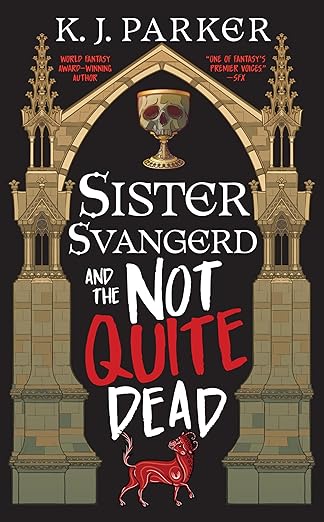
 As a product of the Catholic school system from second grade through university, I have sat through A LOT of religion and theology classes. Heresies, schisms, saints, martyrs, whatever, I feel pretty well versed in church history. While KJ Parker’s Sister Svangerd and the Not Quite Dead is a fantasy novel, it leans hard into Christian church history and theology, setting up some good old fashioned good versus evil scenarios, but it’s not always clear who is good or evil. That’s intentional, but while Parker clearly knows his history and theology and wants us all to have some fun while he takes us on a wild ride, I feel that he frequently gets too wrapped up in his own cleverness. As a result, plot details get overly complicated and murky and the reader gets as befuddled as the protagonists. Perhaps that is also intentional, a way to get me to move on to book 2 whenever it comes out.
Brother Desiderius is an intellectual who loves manuscripts, is well read, and is an excellent forger. He is also as assassin and, despite being a monk, an atheist. In this world, the religion is based on belief in the Invincible Sun and the battle between Good and Evil. Desiderius thinks it’s all a bunch of nonsense, that the lines dividing good and evil are pretty fuzzy and easily manipulated, but he loves scholarship, reason, and intellectual arguments, so the church is the place for him. When his superior announces that he is sending Brother Desiderius on a mission to assassinate a princess (because Good requires it), Desiderius is not enthusiastic until he finds out that his partner will be Sister Svangerd and that the assassination will take place at the Ecclesiastical Council. Svangerd is an old friend (and maybe he has a bit of a crush on her) and a formidable weapons specialist, so Desiderius will rely on her to do the wet work that she loves while he takes in the scholarly slugfest. Naturally, nothing is going to go as planned; the duo is attacked by some incompetent thugs of mysterious origin and Desiderius just happens to find very rare manuscript that could destroy Mother Church if it becomes public. At the council, Desiderius is accosted by some odd little gray-clad monks who seem to know exactly who he is, what he plans, and even how he thinks. But who are they? Should he trust them or fight them? Are they good guys or bad guys? This is the question the reader has through the whole story as well, and in the end, like Desiderius, we are left pondering what “good” and “evil” even mean. They are so intertwined that basically any action can be justified depending on who you talk to.
Parker provides interesting backstories for Desiderius and Svangerd that are important to the overall story. Both come from impoverished backgrounds. Svangerd, unlike Desiderius, is a true believer. She takes religion very seriously but her path to the sisterhood was a rocky one, as she had previously worked as a prostitute. Desiderius came from a dirt poor backwater called Mesoges, known for producing “walkers,” ie, undead of extraordinary power and almost perfect indestructibility. When walkers show up at the council, Desiderius and Svengard have to figure out who they are serving and how to eliminate them from the picture.
As mentioned above, sometimes Parker’s love for the minutiae of theology and intellectual debate can get a bit overbearing and confusing, but there is a lot of humor as well as fighting, suspense and political intrigue. I got through this one in a few days.
