Dear Ms. Limburg,
Thank you for your book. Since my own late autism diagnosis, I’ve been reading everything by and about autistic women I can get my hands on. Your “Letter to the Reader” included a great list of books, some of which I had already read, or heard about, but many I had not. Books that teach me things are my favorite kind, and even before the letters proper started, you taught me many things.
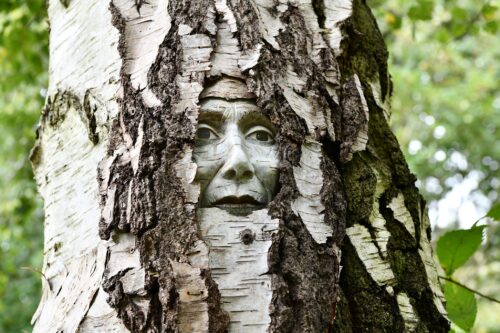
“Bayfield Hall Sculpture Trail, ‘Three Weird Sisters’ by Meg Amsden – geograph.org.uk – 7630457” by Michael Garlick is licensed under CC BY-SA 2.0 

 .
.
Obviously the only way to review your book properly was to open a dialogue with you in the same way that you decided to dialogue with the past. I loved your use of letters as a framework because it indicates that there’s a relationship between the past and the present, something I think so many people forget. We think of the past as something that has nothing to do with us, when it’s literally where we came from, who our ancestors are.
Beginning with Virginia Woolf was a good opener. As you pointed out, she’s so very well known, which makes her a good entry point for conversation. On top of that, I’m pretty sure that, for us women of a certain age, admiring Virginia Woolf is part of our diagnostic criteria, and there should be questions about it during the autism assessment. I remember how it felt to encounter Woolf’s writing for the first time, loving the way her brain worked, following her thoughts easily as they wound around. Reading your thoughts on Mrs. Dalloway created an ourobouros between you, me, and Virginia: you and I responding similarly, albeit from different vantage points and ages, to the things she so desperately needed and wanted to say about herself through fiction.
The other women you chose to write to–Adelheid Bloch, Frau V., and Katharina Kepler–were unknown to me, but through your letters to them I feel I understand so many things so much better. I especially appreciated, and wanted to honor, your thoughts on being an autistic mother. I do not have biological children, and so I cannot begin to understand, but I’m grateful for the chance to bear witness. I think of all the autistic mothers, known and unknown, and us, their weird daughters, and I feel, at long last, like I’m part of a lineage.
Close as the material is to my heart, I was also able to zoom out a bit and see how a neurotypical reader might approach this text. Your focus on recurring traits rather than labels, and your refusal to diagnose anachronistically, softens the unfamiliar territory a bit for the NTs. You’re asking them to look at the patterns and draw their own conclusions; along the way, you’re gently educating on the history of things like so-called refrigerator mothers and IQ testing. It’s a very accessible book, one that women of all neurotypes could sit down and have a conversation about. And that would be a huge leap for feminist progress, given the uncomfortable history most autistic women have with their NT counterparts. Anything we can do to bridge that gap and help them see us as we are, not as they imagine, is helpful.
I’m sorry I can’t give you the thorough, scholarly, intelligent review you deserve. I simply had to let you know how much this book resonated with me. I’m recommending it to my local weird sisters, and will definitely be buying my own copy to reread, underline, and take notes in. And please accept my condolences on the loss of your friend, to whom the book is dedicated.
Sincerely, LAF, keeping it weird since the late 19th century.
