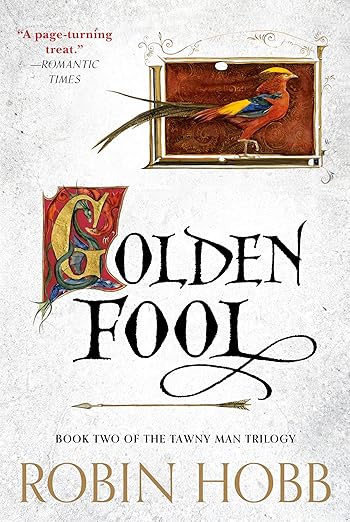
 This second book in The Tawny Man Trilogy was every bit as excellent as the first. Most of the action takes place at Buckkeep castle, where Fitz and the Fool grew up and first got drawn into court intrigue. Given the years that have passed and the changes in their appearances, the two men are not recognized by any who would have known them before, and the fact that Fitz is masquerading as Tom, the servant to the Fool’s Lord Golden, gives him further anonymity. No one pays attention to servants. Golden Fool continues with the storyline of the persecution of the Witted and the rising power of a group of Witted rebels known as the Piebald. After Fitz and the Fool thwarted their attempts to kidnap and use Prince Dutiful for their political ends, the two become targets for the Piebald conspirators. Amongst the Witted and Piebalds, it is known that Tom (Fitz) and Prince Dutiful possess the Wit — a magic seen as dirty, an abomination worthy of death — and that if it were common knowledge, it would destabilize the Farseer Dynasty in the Six Duchies. Golden Fool deals with the unfolding political machinations of the Piebald, but of course there is much more going on at Buckkeep that will complicate life for Fitz and those he cares about.
In addition to the Wit/Piebald storyline, Golden Fool introduces a new plot involving Prince Dutiful’s betrothal to a girl from the Outislands— a cold and barren land to the north known for its violent raiding. The Outislanders were responsible for the Red Raiding that occurred in The Farseer Trilogy; the Red Raiders not only raided and pillaged the coastal towns of the Six Duchies, they also murdered, raped and “forged” the people. Forging involved some sort of magic (we think) that turned people into zombie-like creatures, inhuman and dangerous. Queen Kettricken believes that given the passage of time, the way forward is to create a marriage bond to these folk from the frigid islands to the north. In Golden Fool, Dutiful’s intended, the Narcheska Elliania, comes to court with her entourage for the betrothal ceremony, but there is something strange and offputting about this girl (who is only about 11-12 years old) and her family. It is interesting to note that Outislanders, who have a decentralized form of government amongst their lands, are ruled by women. They have political influence and dominance. Hobb has created a few kingdoms where matriarchy rules and I do love that. Nonetheless, as Fitz uses the castle’s secret passages to spy on the Narcheska, he makes some puzzling and horrifying discoveries, and Prince Dutiful is manipulated into agreeing to a potentially deadly challenge from his young bride-to-be. The next volume in this series will be about that challenge and I am excited to read about it.
The other plotline of interest involves Fitz’ relationships with teens who are like children and/or students for him. Fitz’s adoptive son Hap is apprenticed in Buckkeep town, but he is struggling. Hap is dazzled by town life and has fallen in love. He neglects his work and gets himself into trouble with his girlfriend’s family. Fitz is at a loss; he remembers being young and in love and also how he resented and bucked against the grown ups in his life telling him what to do. Meanwhile, Fitz has also been charged with taking on Prince Dutiful as a student to teach him to Skill. The Skill is a telepathic magic that runs in the Farseer line. The problem is that Fitz was never properly taught to Skill due to his uncle Regal’s nefarious interference. Moreover, there is no one else around who has known Skill talents, so Fitz has to try to learn more about the magic from scrolls even as he tries to teach Dutiful.
So so so much happens in this novel! I don’t have the room to discuss it all but here are a few things that stood out for me:
Thick. Thick is a new character in the series and promises to be an important one. Thick is a young man (not sure how old he is supposed to be) who has an intellectual developmental disability. He is a servant to Chade and mostly just brings up water and wood for his fire, but the first time he meets Fitz, he blasts him with powerful Skill. Chade had no idea that Thick had the talent (it takes one to know one) but Fitz is worried. Not only does Thick have this magic but he DOES NOT LIKE FITZ. Chade decides that Fitz should teach Thick and Dutiful the Skill, but first Fitz has to figure out how to reach Thick. I love the way Hobb handled this. I mean, tears in my eyes sometimes. When Fitz spends time with Thick, learns about him and his Skill, he sees something that others don’t: Thick is different, not less. I nearly fell off my chair when I saw those very words in the story because it was published in 2003, and Temple Grandin’s book of the same name came out years later. I was under the impression that she had coined that expression but maybe not! Anyway, Hobb’s way of writing about Thick’s ability is just beautiful, as is the way Thick’s presence changes those around him.
Chade. Chade is getting older and it becomes concerning to Fitz when it seems Chade is becoming forgetful. But more concerning is a development in Chade’s abilities that happens toward the end of this book. Fitz and the reader have reason to worry that Chade could be putting himself and others close to him in danger.
The relationship between the Fool and Fitz. Fitz and the Fool seem to be moving along nicely with their Lord Golden/Tom the servant masquerade until some folks from the Fool’s past show up unexpectedly at Buckkeep. All of a sudden, Fitz is presented with information about the Fool that makes him do and say stupid things (not the first time) and it damages their friendship at a crucial time.
As ever, Hobb provides an action-packed story with lots of thrills, fights, secrets and surprising revelations. I feel like my reviews really can’t do justice to these books and how well constructed and absorbing they are. They are hard to put down!
