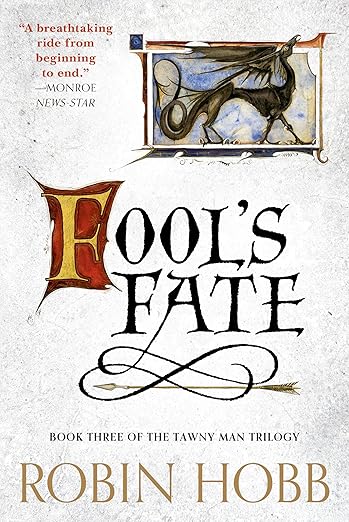
 I am completely satisfied with the end of this trilogy but sad nonetheless that it is over. In Fool’s Fate, we pick up with Prince Dutiful and his coteries of Skill users and of “Old Blood” witted folk as they set sail on the Prince’s quest. In order to win the hand of the Narcheska of the Narwhal clan, Elliania, Dutiful has made an oath before his nobles and the representatives of the Outislander clans that he will deliver to the Narwhal clan the head of the black dragon that is frozen in the glacier on a remote island. A marriage between Dutiful and Elliania would cement an important alliance between the Kingdom of the Six Duchies and the Outislanders, who have traditionally warred with each other. But Elliania’s challenge to bring the head of the dragon seems to have surprised many and while her reasoning is that this boy prince must prove his worthiness, it seems that there is something else going on that the Outislanders do not want to reveal. Is this a trap? Or can diplomacy, valor, and true love win in the end?
Given that this is a dragon quest, you know that the gang is going to encounter danger and treachery, and there is plenty of suspense in this story. The involvement of Fitz and the Fool will of course bring even more excitement and trouble. Before embarking on this quest, Fool reveals to Fitz that according to his visions as a white prophet, he himself will die on it. From Fitz’s point of view, that is reason enough to try to prevent the Fool from joining them, but the Fool also reveals that he is opposed to killing the dragon. When Lord Chade learns of this from Fitz, he works to make sure the Fool never makes it on the ships that are to sail north. Fitz is torn; on one hand, he loves his friend and will do anything to save his life but on the other, he knows he has betrayed the Fool by revealing the Fool’s intentions to Chade. The quest is further complicated by other factors. Thick is an intellectually disabled man who possesses incredibly powerful Skill talents. Chade insists that he must accompany them on the quest, but Thick HATES the days’ long sail that takes them north, and his attitude (fed by his Skill power) plus his disability make him an object of scorn and laughter from both the sailors of the Six Duchies and the people of the Outislands. There is one scene that hit me pretty hard where Thick is having a meltdown over getting back on another boat, and Fitz, who is tasked with shepherding him, is frustrated and embarrassed while being stared at and derided. Been there, done that! Another complication is that amongst Dutiful’s witted coterie (those who have a magic that allows them to bond and communicate with animals, long thought to be an evil and dirty magic), and amongst some of the Outislanders who are sent to help on the quest, there is a growing feeling that killing the dragon is perhaps morally and ethically wrong.
Yet the biggest and most dangerous obstacle is the White Lady. Throughout the series, we have learned that a white prophet appears in every age along with a catalyst, someone who can bring about change that will shift the world’s course in a new direction. The Fool is a white prophet, but he was not recognized as such by the community that formed him. Instead, another prophet, the White Lady, was dubbed the true prophet. The Fool and the White Lady have completely different ideas about which way the world is meant to go. They each have the ability to see multiple futures and the ways they might be achieved. The White Lady has had a particularly deadly and violent catalyst. The Fool has had Fitz, aka “changer.” You know there is going to be a showdown and it gets pretty horrible and violent.
Highlights of book three:
Nettle. Nettle is Fitz’s daughter by Molly and she happens to possess the Skill. Given that this is a telepathic magic, Skill users can connect mentally with one another across vast areas. Nettle has been trying to connect with Fitz, who is a powerful Skill user, but she doesn’t know who he is or that he is her father. She has been raised by Burrich, Fitz’s father’s stable master and right hand man who was tasked with taking care of Fitz growing up. Burrich and Molly, like the rest of the world, are unaware that Fitz is alive. Everyone believes he died 15 years ago and while Fitz longs to be with Molly and his daughter, he knows that he can never have that, that the knowledge of his existence would destroy their lives and bring only heartache. Anyway, Nettle’s Skill abilities allow her to make powerful connections through people’s dreams and even to influence those dreams for better or worse. Fitz is torn between wanting to know her and wanting to protect her from the danger that can come from being a known Skill user.
The witted coterie. The persecution of those who possess the Wit has been an ongoing theme in the series. Queen Kettricken, who knows that her son Dutiful and Fitz have the Wit, has been trying to promote tolerance and understanding amongst her subjects while not telling them about the Wit in her own family. Dutiful’s group of witted advisors (his coterie) includes a man named Web, who is a knowledgeable, friendly and gentle man, wise in the ways of the Wit, and, unexpectedly, Swift — son of Burrich who has run away from home due to his father’s disgust at his magic. The thing is, and we know this from The Farseer Trilogy, Burrich himself possesses the Wit, and his power, which he loathes and denies, is formidable. There are some powerful passages in which characters discuss the Wit and the stigma that has been attached to it, and the damage that that ignorance has done to those who possess it.
The Fitz-Chade-Fool triangle. Throughout this series, the power dynamic between Fitz, the Fool and Chade has been central. Chade, who has known Fitz since he was a boy, is himself Fitz’s great uncle and sees him as a son. But Chade has also always been enamored of the power Fitz possesses. Chade, now out of the shadows as an advisor to the Queen, has great ambition for himself and the Farseer dynasty, and Fitz is his secret tool. The Fool and Fitz met in childhood at King Shrewd’s court. The Fool was Shrewd’s jester, his Fool, his entertainment, but the Fool is older than his years and has recognized Fitz as the changer, the catalyst whose choices and actions can nudge the world in a different direction. The Fool has been honest about this with Fitz, but now in adulthood, Fitz finds himself torn between his duty to family and the crown and his unique and beautiful bond with his friend. There are some gorgeous, heartbreaking passages here between Fitz and the Fool. Ultimately, Fitz has to decide; he has to learn to live with his decisions, knowing that people he loves may be angry, upset and hurt by them. Fitz’s growth in this book is wonderfully written. I love his choices and his genuine, human response to the recognition of his own pain and grief as well as that of others.
If wouldn’t be a Robin Hobb novel if your heart didn’t get broken, and it will if you have been a fan of the series since The Farseer Trilogy. Yet, there is also happiness, humor and a recognition that grief and depression are a part of life that must be addressed. I really love all these characters and have loved sharing their pain and their joys. This is a series I will revisit.
