It’s been a weird year–a lot of work stress, some painful if not acute health stuff, a lot of messy emotional knots, or perhaps unraveling, a lot of therapy, and reader’s block. But in the last days of the dying year, I did two things I have not done for a long time, one of which was stay up most of the night to finish a book. And that book was Caroline Palmer’s Workhorse, which I picked up in hardback on Christmas Eve because I loved the cover, despite the fact that there are no crimes or magicky things in it.
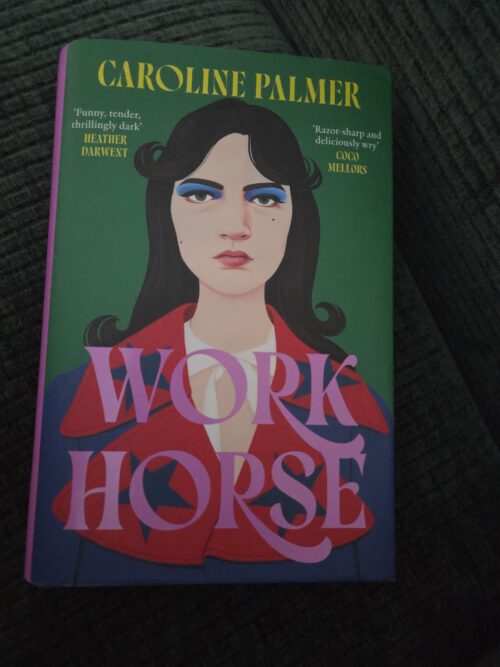
Or are there? It’s not a thriller, as such, nor is it fantasy–but there is deception and glamour. This is about glossy magazines, after all, and the illusions they create, and the shape-shifting and unreliable narration necessary to maintain these illusions, and how deep this unreliability goes. Palmer’s commentary on the media landscape between 2001 and 2009 and the shift from journalism to content creation is astute and entertaining, the nostalgia for the weight and heft and sheen of high-end print publications as sharp as a paper cut.
Clodagh Harmon is a junior editorial assistant at an unnamed magazine in 2001, around September, when New York is vibrating with tension and the glitterati are partying hard. Her cubicle mate is Davis Lawrence, who is everything Philadelphia-born Clodagh is not; she’s patrician New York, the daughter of a fading actress, the granddaughter of tycoons. Davis is what Clodagh calls a showhorse, as opposed to the pedestrian workhorse that Clodagh feels herself to be, always awkward, always too big, always out of place. Clodagh is obsessed with gaining Davis’s friendship and approval, a secure place in her life, but she also wants her life from the inside out: her graceful bones, her invitations, her mother, but most of all her “vast carelessness”; Davis is one of Fitzgerald’s ‘careless people’, a flapper transplanted into the early twenty-first century. Davis never has to try; Clodagh is never not trying (in all senses of the word).
[A]fter rustling around for a bit, Davis gets quiet. In our shared silence, we listen to the ocean. It is so close to the house that it sounds like some otherworldly kind of radio static and as I listen to it mixed with Davis’s breath, I imagine we are waiting for an important broadcast during wartime. I imagine we will be called to an important task. I imagine we will rise to the challenge. I imagine we will emerge patriots. I roll over to tell her this and she tucks her elbow underneath her head and turns towards me to listen. In the darkness, I can see that her bottom teeth overlap just slightly, and there is a permanent retainer affixed to them which is a private detail previously unknown to me. I find it thrilling to know this about her, and even though I feel drowsy and drunk, I fight to stay in the moment. We whisper and talk and giggle for just a little while longer, and the sheets are so crips and cool that it feels like I have died and gone to heaven. (183)
But what Clodagh comes to find is that Davis’s relationship with her mother is volatile at best, and her friendships may be lifelong but shallow. Clodagh doesn’t have the capacity to care, however, or revise her desires accordingly; she’s blinkered by self-interest and booze and sometimes cocaine, and her white-hot desire to be at the centre of the universe stops her from noticing the entropy of it all.
The comparisons to The Talented Mr Ripley (Patricia Highsmith, 1955) are inevitable, which Palmer acknowledges with a sly nod in the book, as are comparisons to The Devil Wears Prada (Lauren Weisberger, 2003). There is certainly a thread of the gossipy fun of the latter through the book, and Clodagh is as fascinatingly amoral as the Tom Ripley of the former, as well as racked with insecurity (and the way Clodagh’s insecurity is inscribed into her flesh from the inside out veers towards body horror at times). What I liked most, however, is that Palmer pulls off, mostly, the admirable trick of letting the reader know more about Clodagh than she knows about her self, if indeed she has one.
CN for the book: eating disorders, domestic violence
Title quote from ‘Pure Morning’ by Placebo
