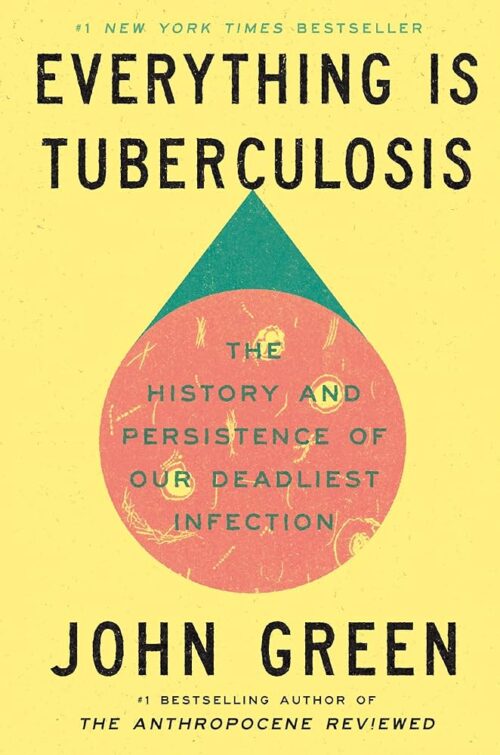
 Maybe not everything, but a surprising amount for sure.
Green is entirely right that I don’t give much thought to tuberculosis. It feels like a historical disease, like scurvy. But of course, tuberculosis is still enormously pervasive in certain parts of the world. It’s interesting to me that he focuses on the way the disease is ravaging parts of Africa when even within North America there are communities being affected. For example, here in Canada, of the 23.8% of cases of tuberculosis that manifest in people born in Canada, 3.5% are in non-Indigenous people, while 18.1% are in Indigenous people. It makes Green’s point for him even more starkly. The disease is where the cure isn’t, and the cure is where the disease isn’t. Even within the same national border.
But of course, Green’s knowledge of the disease is focused on Henry, the young tuberculosis patient that sparked Green’s interest in the disease years ago, and turned him into a rather intense advocate for the democratization of access to the medication. Balancing the sort of meta data that is necessary to demonstrate the urgency and scope of the problem with those affected by it is difficult, and I think Green does an unusually excellent job. It’s one thing to show people being hurt by an issue, but Green shows you not only the ways in which their lives have been shaped by tuberculosis, but also their passions, their hopes and dreams, and their flaws. They are people first, and people affected by tuberculosis second.
The last thing I’ll say is about Green’s call of action. The world is a complicated place. Problems are always multi-factorial, and addressing one thing in isolation will often do little if not outright harm. As Green demonstrates, tuberculosis is also a complex disease made all the more complex by politics, medical trauma, and superstition. But the solution is as simple as a block of wood. Get the cure to where the disease is, and make it affordable enough that the countries that need it aren’t risking bankruptcy to get it. I suspect it is the simplicity of this solution that has allowed Green and his Nerdfighters to make gains for tuberculosis sufferers.
So maybe this is actually a blueprint for how to make change. Find an issue you are passionate about, learn enough about it to understand the underlying factors preventing progress, and starting with the simplest, work to dismantle those factors. And always, always, do it with your community.
The audio is read by the author and unsurprisingly he does an excellent job.
