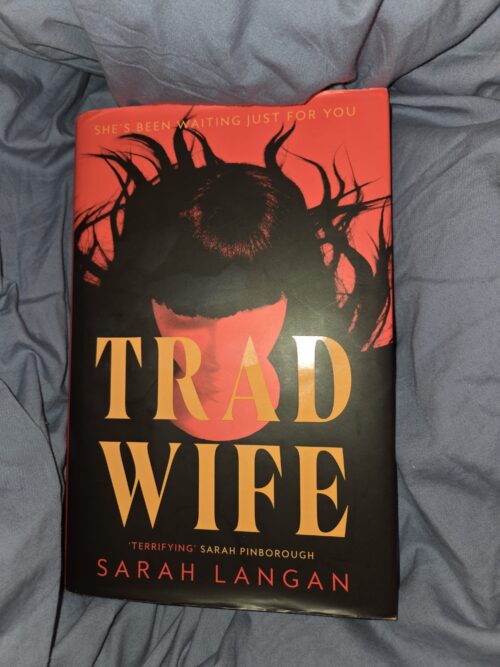
 Jenny is a journalist clinging desperately to a job on an actual publication in a world of listicles and TikTok. Mia Wright lives on Black Swan Farm, 300 acres in Pennsylvania, with her ineffectual husband and their many children, and has a successful career as a trad wife–a contradiction in terms, of course, that’s blatantly obvious to everyone but to which trad wives must pretend to remain oblivious in order to maintain their purpose. Jenny is dealing with various family traumas and relationship traumas–she and her partner broke up when he descended into some sort of disorder as a result of being a medic during the height of the Covid pandemic. This is very much a novel set now, while flashing back occasionally to the days of the original settler-colonialists in the ‘New World’, and the darkness at the heart of their communities, as well as early American horror.
When Jenny is commissioned to write a profile on Mia and her family and their idyllic acres, Black Swan farm initially seems like a respite from the crumbling world outside–Jenny’s life is not easy by any means–especially as Mia is far kinder and friendlier than she expected. Despite their bonding, however, Jenny starts to notice the duct tape that (barely) holds the farm’s sets and props together. Mia is not the relatable klutz who trips over the dog in her kitchen when she’s making dinner from scratch for nine, nor the glossy but earnest mother speaking from the heart to other mothers, nor the young woman projecting effortless glamour. She’s not even just the steely head of a pyramid scheme or the Karen getting books banned from the local library. The mystery of Black Swan Farm turns out to be linked to those early Puritan settler days when women were commodities–but it’s a dangerous mystery for Jenny to unravel, even as she herself starts to feel her world crumbling within her and without her.
I quite enjoyed a lot of it; the early stages are very readable for their satire on the curated world of the influencer and the corrupt world of the media industry. But a number of high-profile, even royal, figures in the horror world have given this novel at lot of hype, and I don’t quite get why. Black Swan Farm is, of course, a nod to Ballerina Farm but if you’ve seen Black Swan (2010), you get a decent sense of some of what’s coming. There’s also some other signposting that would seem quite obvious to even the most slightly competent reader. The resolution to the mystery involves a lot of lore, which to me somewhat undermines the effect of the whole novel–the way that everything is explained is gruesome, to be sure, but it makes the everyday sinister and claustrophobic nature of the farm, and indeed the trad wife life, seem less unsettling by contrast. And yes, I know it’s a metaphor, but it’s a metaphor that consumes rather than supports the central theme of the text. It’s hard to explain without spoilers, but I will say that to me the moment that elicited the most shivers down my spine was when Jenny realises that one of the children is not allowed to use an inhaler for her asthma for ideological reasons.
That‘s the kind of horror that needs to be dragged into the light.
Title quote from Sleater-Kinney’s ‘Dig Me Out’ (1997).
