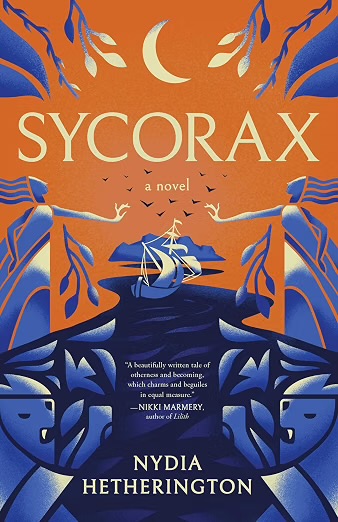
 In Shakespeare’s The Tempest, Sycorax was a witch who had been banished to an island where she gave birth to her son Caliban. Sycorax is already dead and gone when The Tempest takes place, and what we know of her comes from Prospero’s angry rantings about the “blue-eyed hag.” Shakespeare does not provide much information about Sycorax other than that she was a witch, she had been banished to the island for her sorcery, she was not executed because of some valuable service she had performed, and she was pregnant. In her author’s note at the beginning of the novel, Nydia Hetherington notes all of that (I have never read The Tempest and I only have a Cliff’s Notes knowledge of it). This novel is what Hetherington imagines Sycorax’s backstory to be: who her parents were, where she lived, and what she had done that saved her from a death sentence. This is a novel about strong, smart, talented women and about the fear, prejudice and demonization such women face. Add to this that Sycorax is also disabled and she becomes an even greater object of fear, misunderstanding and abuse.
Hetherington imagines a Sycorax who was the daughter of a magical woman of the desert, part of a long line of magical women. Her mother Atlas had a way with birds and other animals, and knew herbs, plants and their healing properties. Her father Sunny was a man of the earth who excelled at beekeeping. When Atlas and Sunny came together, in an unusual and magical sort of way, they were passionate about each other. They settled in a small port town and sold candles, honey and baskets. When their daughter was born, they named her Raven and doted upon her, but Sunny was worried about her from birth. Raven, whose skin was dark like her mother’s, had deep blue eyes, the kind of eyes that startle people and might draw negative attention, and so Sunny insisted that she always keep her eyes covered when out. Raven/Sycorax also had physical deformities; one was acquired due to an accident, the other was inherited from her mother. Atlas, like her foremothers, suffered from physical pain that sounds a bit like rheumatoid arthritis, and Raven/Sycorax inherited this at a young age, becoming bent over and needing a staff to walk eventually. The superstitious townspeople interpreted the child’s condition as a sign of evil and dirtiness and began calling her Sycorax, which means Pig-Crow. Atlas, who endured her fair share of negative attention and comments, laughed at the ignorant villagers and walked about proudly, and Sycorax tried to do the same, but after losing both parents tragically at a young age, Sycorax found herself alone and defenseless until a village crone named Yemma became her friend.
Sycorax’s magic is difficult to define, and it is something she didn’t fully understand until later in life, but there were two things she was known for in the village: making dreamstones to ensure pleasant dreams, and being able to predict the weather. When enemies threaten to invade by sea, the local governor Barbarossa reaches out to Sycorax through a councilor named Afalkay the Beautiful, to get her prediction about conditions for the invaders. What ensues has enormous ramifications for the village and for Sycorax.
While I found the plot intriguing, I was ultimately a bit underwhelmed by this story. The nature of Sycorax’s and Atlas’ magic was a bit murky to me. Atlas’ dedication of Sycorax to some god named Setebos when she was born had significance to Sunny (and really bothered him) but we never get an explanation of why. The story sometimes dragged along, especially when Sycorax is on her own and in her head so much, but when she starts to interact more with the villagers and officials, it picks up. Also, the descriptions of Sycorax’s disability and its impact on her daily life and her relationships within her community were quite compelling. People fear what is different and what they don’t understand, often with disastrous consequences for all.
