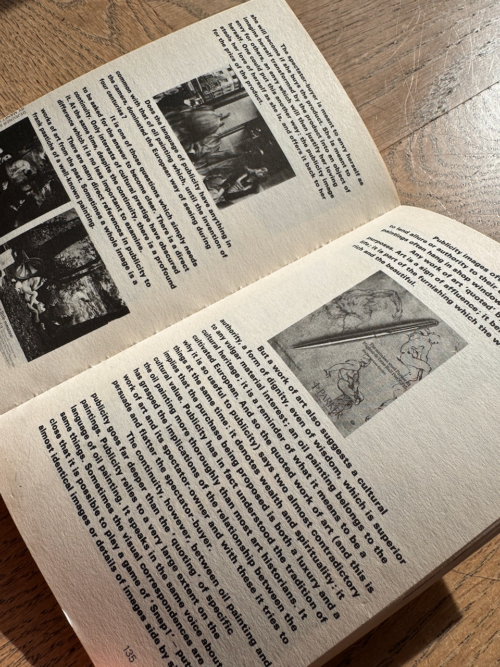
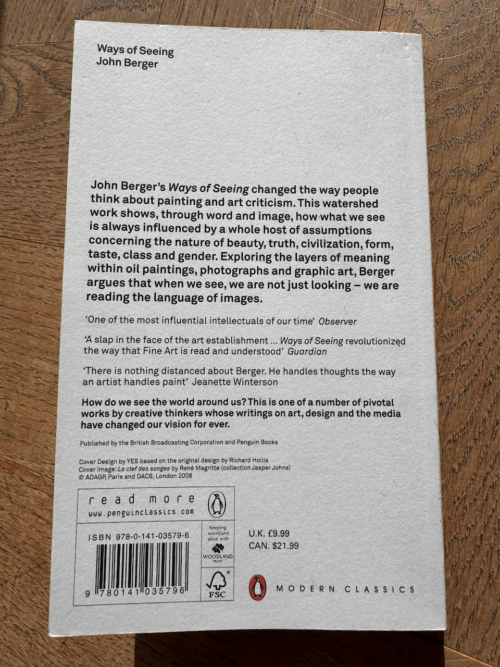
If you are the kind of person who would enjoy reading a historical oil painting to filth; if you would like to understand why art museums are “like that”; if you have always been slightly confused by the (financial) system of worship so easily observed in art galleries around the world: Ways of Seeing is the book for you.
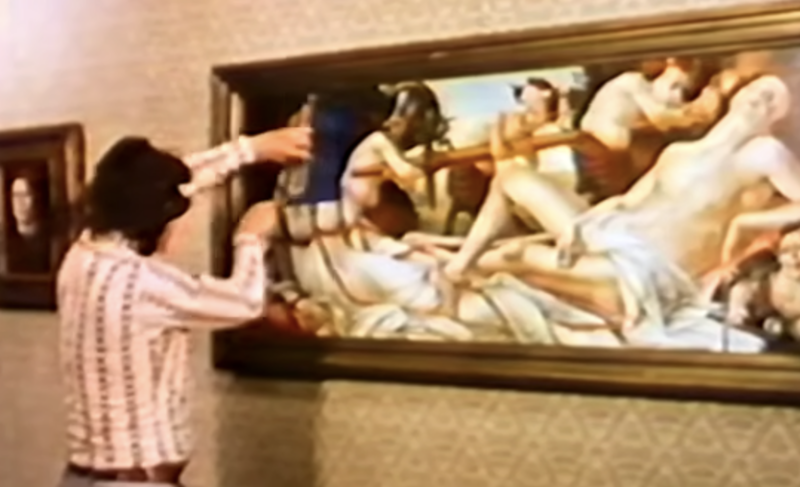
Or, perhaps, this is the 4-part BBC miniseries for you. The miniseries memorably opens with the host, John Berger, taking a boxcutter to a Botticelli. At first, this is a shocking and reprehensible act of destruction. But through the course of the 2-hour programme, Berger’s actions will feel more and more justifiable, and the paintings themselves more and more reprehensible, until you yourself are ready to chop up some 18th-century masters.
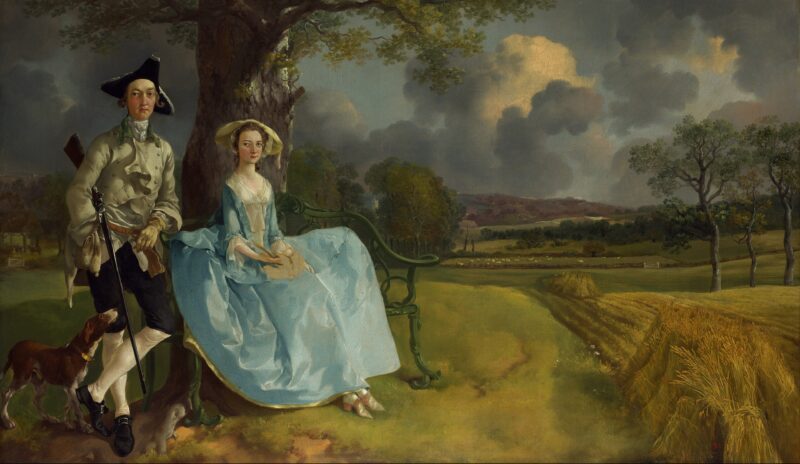
This book is an extension of that programme — itself inspired by Walter Benajmin’s 1935 essay “The Work of Art in the Age of Mechanical Reproduction.” Like its predecessor, Ways of Seeing surveys the European tradition of oil painting, draws a line between the surveying gaze of Mr & Mrs Andrews (Gainsborough, ca. 1750), and the incessant barrage of visual images deployed by advertising operating in our daily lives. And though it was published well before Instagram and TikTok, it is not difficult to extend that line to today’s consumer influence campaigns.
The crowning thesis of this work — the “once you see it” perspective that will forever immunise you to many sorts of advertisements — goes approximately like this:
Publicity relies to a very large extent on the language of the oil painting. It speaks in the same voice about the same things…
There are several reasons why these [publicity] images use the language of oil painting. Oil painting, before it was anything else, was a celebration of private property. As an art form, it derived from the principle that you are what you have. It is a mistake to think of publicity supplanting the visual art of post-Renaissance Europe; it is the last moribund form of that art…
Yet, despite this continuity of language, the function of publicity is very different from that of the oil painting. The spectator-buyer stands in a very different relation to the world from the spectator-consumer.
And finally, the triumphant conclusion:
Publicity turns consumption into a substitute for democracy. The choice of what one eats (or ears or drives) takes the place of significant political choice. Publicity helps to mask and compensate for all that is undemocratic within society.
In the television series, this point is made with astonishing effect, by simply flipping back and forth between two pages in a magazine: one with an image of an exhausted refugees, the other selling soap. This contrast — one we’ve all seen so many times — becomes so severe as to temporarily sever us from our own sense of normal, allowing us to observe our culture as an outside might. And so, John Berger begins with the museum plaque, and ends on the shaky status on Western democracy — a tour de force through visual imagery and time.
Given the avalanche of visual images we are subject to, I believe this book would serve well as mandatory reading in high schools. Critical literacy of the image is just as important as critical literacy of the written word, despite the implicit moral hierarchy. After all — “seeing comes before words.”