Fitting, that my first reviewed book begins with a photo of a trash can. Fitting also, that the only book of substance in Foyles’ Interior Design section should be so slim and so plain. I only found this unassuming paperback after about fifteen minutes of rifling through glossy tomes. But perhaps that is fitting too: “when the student is ready, the master will appear.”
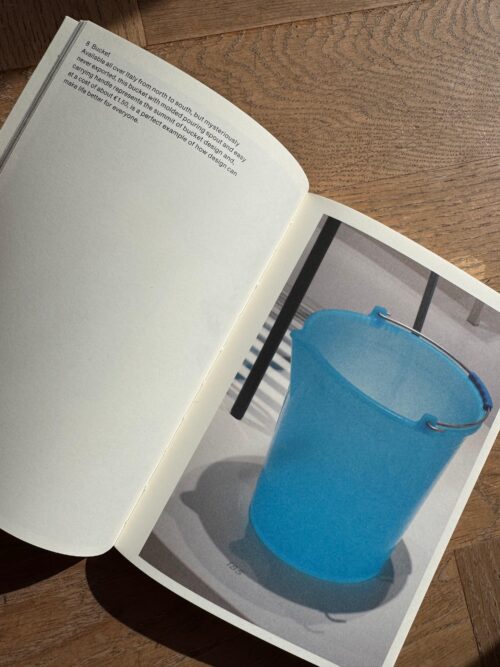
At first glance, Super Normal seems like absurdist humour. For example, a photo of a plain blue bucket is captioned:
Available all over Italy from north to south, but mysteriously never exported, this bucket with molded pouring spout and easy carrying handle represents the summit of bucket design and, at a cost of about €1.50, is a perfect example of how design can make life better for everyone.
Although this book is approximately 80% photo by surface area, it should not be taken lightly — it’s a visualiser of an exhibition, not an adult picture book! Reading further, I found it to be a serious treatise in response to “Design” fetishes of popular culture. A backlash to objects that “shout,” or “do not blend in” with people, environments, circumstances, and lifestyle. Fukasawa and Morrison remind us that the best of design is often unbranded, anonymous, so normal as to be “super” normal.
For clarification — hidden too far in the book — the designation super normal arises from an incident in which one of the authors visited his aluminium stools at a trade fair, and found them missing — they had been distributed among the attendees. He sensed then a fundamental break between what I may call “Designers,” or the resume-building strivers, and “designers”, a humbler occupation. In the authors’ words, “the appeal of Super Normal lies in the idea that our relationship with things we aren’t usually aware of is richer than with things that are viewed in terms of design.” Perhaps not a surprise that both authors’ have collaborated with the Japanese brand Muji, whose full name translates to “No Brand Quality Goods.”
This book is a simultaneously a philosophical treatise on the future of design, and an ode to the mundane items around us that can become cherished through their persistence in our lives, and a small change in perspective. An antidote to design churn, I am certain I will reference and recommend this book for years to come.