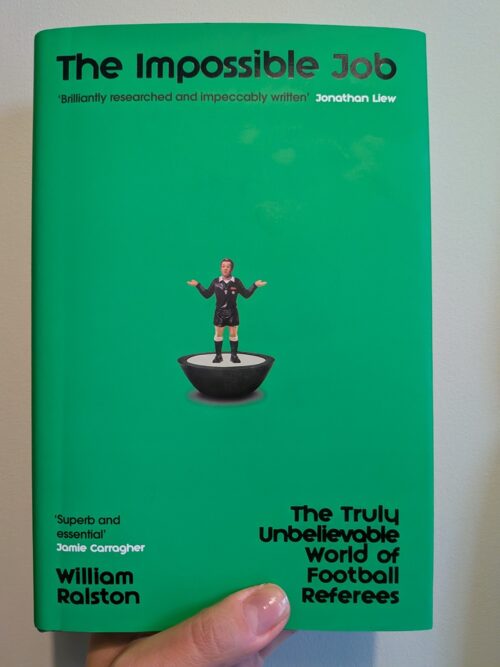
 In a nutshell:
Author Ralston explores the world of football (soccer in the US) refereeing told via interviews with some of the top professionals in the game.
Best for:
Anyone who claims to be a football fan. Anyone who has yelled ‘REFEREE?!’ at their TV (or at a live match). Referees.
Quote that made me think:
“A refereeing error can influence the result, but so does a payer misplacing passes, the manager making the wrong substitution, or a club owner signing the wrong striker.”
“When you’re a coach or a payer, you can have a bad match or even a bad season, but referees cannot.”
Why I chose it:
In my free time, I am a referee in Scotland, generally refereeing grassroots girls matches and the occasional club academy game.
Review:
After nearly 35 years of playing football off and on, a little over a year ago I decided to become a referee in Scotland, and the set-up here is pretty amazing. We have termly trainings where they go over video to discuss calls. There are weekly fitness trainings spread across the geography of the city, where referees of all levels – including the ones refereeing the Scottish Premier League – train together. There’s a dedicated WhatsApp group for women referees, and we get our own trainings. Which might strike folks as odd – why would referees need their own community? Don’t you just show up, piss off players, and go home with some extra money?
This book explains why. Using the clever convention of matching each chapter to one of the 17 Laws of the Game, Ralston explores what it is like to be an elite referee, including how isolating it can be. Obviously very few people will ever reach that level, but the stories in this book are relevant not just to the grassroots referees like me, but to anyone who enjoys sport. There are loads of interesting stories, both infuriating and inspiring – from grassroots referees jumped in parking lots to referees realizing their dream of managing a World Cup final.
Through interviews with professional referees (mostly men, but a couple of women too), Ralston explores the challenges of being a referee. Aside from the obviously physical ones — I I am essentially doing a HIIT workout every Saturday — there are the mental challenges. I remember my very first match, and how exhausted I was not from the running but from paying attention. Where I referee, we don’t have assistant referees, so every single call comes only from what I see. There’s no mentally turning off ever, and it requires so much energy. Look away for just a moment, and a I might miss a cheap foul, or not be able to tell whether the striker going for the ball was offside.
And consider doing all that with people shouting at you. Imagine if you worked on spreadsheets, and when you went to enter a formula in a cell, someone screamed ‘that’s fucking wrong, you idiot’ from a hundred feet away. Or each time you sent an email, one of the recipients stood up and yelled ‘that’s not fair’ from their cubicle, Referees are at work, but players, coaches, and spectators all think it’s totally appropriate to just hurl abuse at them. Now, when I was a player I shouted in frustration, but I never abused or shouted AT a referee, and it is WILD to me how even some of the managers of the clubs I referee for think nothing of shouting inappropriate dissent onto the pitch. Just today, I experienced some abuse directed to me after the match based on my country of origin. (That young lady got herself a card for her troubles.) For higher level referees, multiply that by a few thousand, as well as a few hundred thousand more watching at home, sending abuse via social media and the airwaves.
One area Ralston spends some time on is how white professional refereeing in Europe is. It’s shocking how few referees are people of color and it’s even less at the professional level, and that is partly because of the pipeline — if you don’t have referees of color at the lowest levels, they aren’t there to be in the top flights. And there’s also some evidence that such referees aren’t promoted at the rates they should be, and don’t receive the support they should. Ralston also briefly mentions the lack of women referees, but he doesn’t focus on that. I’m not surprised.
Ralston also examines the limitations of the Laws of the Game. As I said above, there are 17, but some of them have to do with things like the size of the pitch or the equipment players and referees must have. While most of those do reference what to do if there is an infringement, only a couple of the laws talk about specific ‘fouls’ – and the designations that mean the difference between just a standard free kick and someone getting sent off the pitch. So much is up for interpretation, and the best referees know how to apply the laws while keeping with the spirit of the game and what the game expects. It’s such a challenging balance, and most folks who enjoy football don’t seem to really get that.
This is a very long review mostly because I really enjoyed the book. I got some ideas out of it, some tips, some perspectives that will help me improve my game. But I think the best thing this book does is help the reader have empathy for referees, and for the difficulty of the job. It is literally thankless, yet it is necessary for the sport so many across the world love.
Would I recommend it to its target audience:
Absolutely
