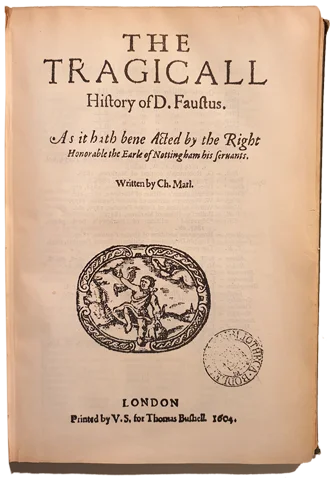
 CBR18 BINGO: Success, because Dr. Faustus sells his soul to the devil to become a successful magician
Notes: The Tragical History of Dr. Faustus exists in 2 versions. The “A” version was published in 1606, and the expanded “B” version was published in 1616. The revisions and additions to the 1616 version are typically attributed to other playwrights, possibly with some input from Christopher Marlowe (both versions were published after Marlowe died, so who really knows for sure). I read the 1606 “A” version, which I downloaded from Project Gutenberg.
I did something unusual with this reading, in that I read the text while listening to an audio recording made possible by LibriVox. I enjoyed being able to hear the music of Marlowe’s verse while reading along with the text. Shoutout to all the volunteers who made both my resources possible!
At the time of his death, Christopher Marlowe was more famous than William Shakespeare. One of my favorite scenes in Shakespeare in Love is the audition scene for Romeo and Juliet, where nearly every actor, including the creepy kid who turns out to be creepy future playwright John Webster, quotes Faustus.
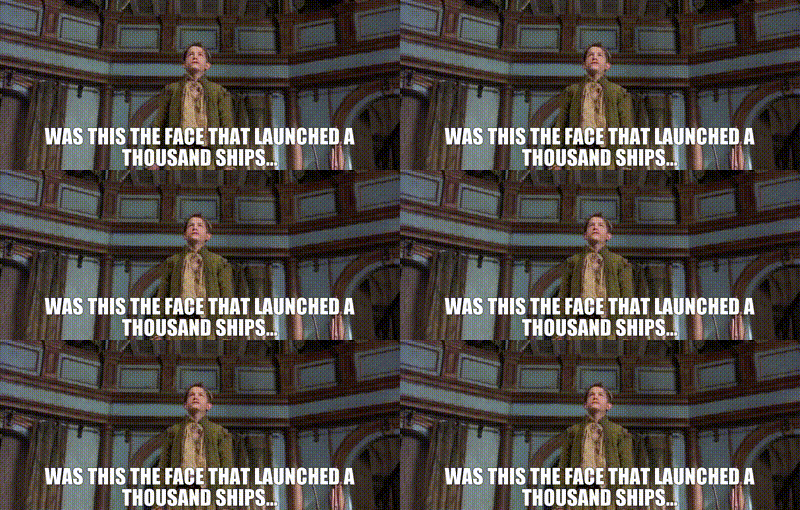
Iambic pentameter, bitches!
Yet I’ve never had the opportunity to see Marlowe performed, in spite of The Tragedy of Dr. Faustus being one of the most famous plays of the English language. I know I read excerpts of it in college, but until now I don’t think I’d ever sat down and read the entire play. I was moved by the beauty of the verse and surprised by the comedy. It’s a dark play with some terribly funny and absurd moments.
At the beginning of the play, Faustus (already a doctor at this point, so he’s a man of high learning) is contemplating what to dedicate his life to. He’s already studied theology and it ain’t doing it for him; economics is boring, and what’s the point of medicine if he can’t make people live forever? But magic, hmm, now there’s something to consider. Quotes Faustus, “Both law and physic are petty wits; / Divinity is basest of the three, / Unpleasant, harsh, contemptible, and vile: / ‘Tis magic, magic that hath ravish’d me.”

It wouldn’t be the last time a good man was lost to the magical arts.
Faustus even goes so far as to say a magician is like a god, at which points a Good Angel appears to try to warn Faustus away from this line of thinking, and an Evil Angel appears to egg him on. This is such a familiar trope nowadays that it’s hard to read this scene without experiencing a flood of cartoon memories.
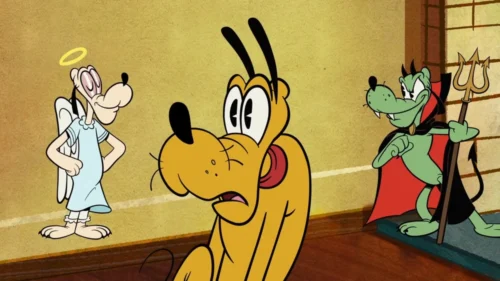
Unsurprisingly, the Disney Corporation is suing the Marlowe Estate for copyright infringement, in spite of Faustus being written 340 years earlier.
After the angels depart, Faustus continues to blaspheme, which prompts Mephistophilis to appear. Unimpressed, Faustus tells him, “I charge thee to return, and change thy shape; / Thou art too ugly to attend on me: / Go, and return an old Franciscan friar.” The stones on this guy, seriously.
Mephistophilis humors Faustus and does as he asks, but when Faustus claims to have summoned the devil, Meph corrects him and says, essentially, “Nuh-uh. I work for Lucifer and I came of my own accord, because whenever I see someone whose soul is in danger, I swoop in and try to take advantage.” Meph goes on to tell Faustus that he (Mephistophilis) is always in hell, because “Think’st thou that I, who saw the face of God, / And tasted the eternal joys of heaven, / Am not tormented with ten thousand hells, / In being depriv’d of everlasting bliss?”
You’d think Faustus would reconsider at this point, but he doubles down and says he wants to talk to Lucifer himself. In fact, he’s going to make Lucifer an offer: In exchange for 24 years of power and success in the art of magic, plus having Mephistophilis as his servant, Faustus will give Lucifer his soul!
Thoughts from the Chorus and me
Needless to say, Lucifer jumps at this opportunity, and contracts are signed in blood.
For the next twenty-four years, Faustus enjoys awesome power, which he uses for such incredible feats as playing tricks on the Pope, cheating horse-traders, and producing grapes in winter.
 A healthy snack is always a priority!
Faustus sometimes regrets his deal, but any time he starts to think about repenting, those angels appear again, with the Bad Angel convincing Faustus that it’s too late for him; no way will God take him back after he signed that contract with the devil in blood.
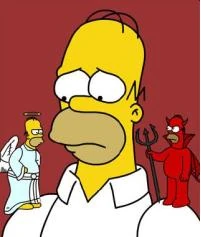
Don’t you start now, FOX Television.
In the end, (after meeting Helen of Troy and proclaiming the play’s most famous lines), Faustus’s soul is claimed by Lucifer. The tragedy is that he never even tries to repent, believing himself to be beyond redemption: “But Faustus’ offence can ne’er be pardoned: the serpent / that tempted Eve may be saved, but not Faustus.”
The devils lead Faustus quietly away, and the Chorus proclaims the story to be at an end. (In the “B” version, some of Faustus’s scholar friends find his body ripped to pieces, which is a bit grimmer, but then they bury him, so that’s nice.)
I thoroughly enjoyed reading and listening to this play. It’s hard not to wonder what might have been had Marlowe not died at such a young age. Some critics say that Marlowe’s work was not in the same league as Shakespeare’s, but remember, he had written only 6 plays before he died. Regardless, The Tragical History of Dr. Faustus remains a classic, and one I hope to see performed on stage in the near future.
