 Cbr18bingo Justice: a murder trial is a key part of the story
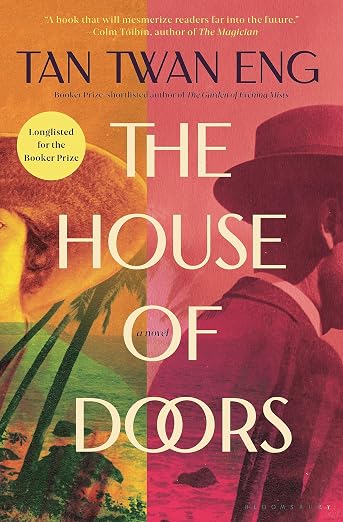
The House of Doors is a work of fiction that includes real people and a real murder trial that occurred in Kuala Lumpur in 1911. The murder trial of Edith Proudlock became the subject of a W. Somerset Maugham story, The Letter, which later became a play and film. In this novel, author Tan Twan Eng imagines how Maugham came to write that story. Set in Penang, Malaysia, it is a story of colonialism, sexism, and homophobia, spanning 1910 to 1947. The main narrators are W. Somerset Maugham (Willie) and fictional Lesley Hamlyn.
The novel opens in South Africa in 1947, with the now widowed Lesley Hamlyn receiving a package containing a Maugham book with a particular seal imprinted on it. Lesley then thinks back to her life on Penang, where she was born and raised. In particular, she remembers when she first met Willie Maugham in 1921. Willie was an old acquaintance of Lesley’s husband Robert, a prominent barrister in Penang. Willie and Gerald (his secretary/lover, and another real person) have spent the year traveling around Asia, with Willie soaking up the scenery and stories as inspiration for his next works. Maugham is at this point a very successful and wealthy, world renowned author who is unhappily married. While staying with the Hamlyns, Willie receives some shocking and unwelcome news. He decides he needs to focus on his writing, and he discovers that Lesley Hamlyn carries some fascinating stories of her own, stories that she has kept secret for a decade.
The nature of Lesley’s secret stories and her reasons for revealing them to Willie are what drive this novel. Through Lesley we learn about the life of colonials in Malaysia, about the rigid class, race and sexual mores of the time, and about Chinese rebellions. Sun Yat-Sen is also a character in this story, and he did in fact spend time in Penang, although it was in 1910, not 1911. Tan Twan Eng puts Sun Yat-Sen’s stay in Penang at the same time as the Proudlock murder trial for plot reasons. Lesley becomes close to Sun Yat-Sen and takes an active interest in his revolutionary activities in Penang. She also happens to be a friend of accused murderer Edith Proudlock, wife of the headmaster at an elite boarding school. Edith murdered a white European man whom she accused of attempted rape. But in the course of the investigation and trial, prosecutors suggested that Edith and this man had been lovers and that she had planned his murder.
While it may seem strange to link Sun Yat-Sen and Edith Proudlock, for Lesely these two are inextricably linked due to her life experience. Through Lesley and her conversations with Willie, we learn about white colonial disdain or indifference to the plight of the Chinese, the obstacles to independence for native people, the homophobia that drove men like Maugham into unhappy marriages, and the double standards that excused all manner of offensive behavior for men while limiting women’s options, particularly when it came to marriage and independence. Along the way, we learn a lot of interesting things about Maugham (his medical training and his activities during WWI) and about Penang. There is also a reference to Anna of “Anna and the King” fame at one point.
Despite the flaws of all the characters — both fictional and real — I think the reader can feel sympathy for them. They are diverse group of people struggling to live and love freely in a world that places terrible, suffocating restrictions upon them.
