 Cbr18bingo Wealth The story opens with Matthew, a wealthy man, found dead in his car
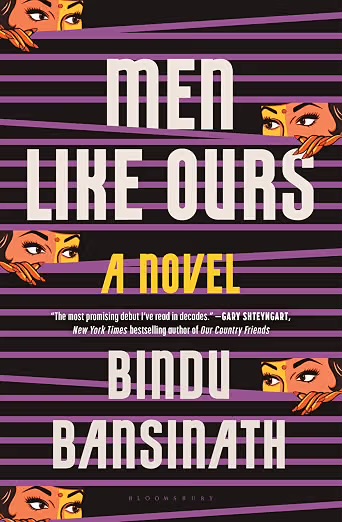
I picked up Men Like Ours at our local library, drawn in by its cover which reminded me of Parini Shroff’s The Bandit Queens. It turns out the two novels are a bit alike. Each features Indian women living in a small-ish communities with similar complaints: financial woes, bad marriages, worries about children, and thwarted dreams. Men Like Ours, however, is set in New Jersey amongst the women of Willow Road. When the body of Matthew Pillai is found in his BMW next to the highway, the Indian community of Willow Road is stunned. Matthew hadn’t lived there but everyone knew him, the wealthy and generous middle aged man who, admittedly, had health problems. Everyone also knew that Matthew had a special relationship with the Sharma family, but we quickly learn that there has been bad blood between the Sharmas and the other families on the street. Author Bindu Bansinath takes the reader back in time to show us who all these characters are, where they came from and how that has influenced the development of their community.
At the beginning of the story, Bansinath provides readers with an index of characters, describing main characters Anita and Leila Sharma, who are mother and daughter, as “a snob” and “a tart.” Anita is not just a snob, she is an angry snob. Born in India, she had excelled in school and dreamed of a career, but her mother and uncle conspired to marry her off to a man more than twice her age in the US. She has never found the kind of career she dreamed of and complains about everything: her husband Ashok, 15-year-old Leila who dreams of an acting career, and the neighbors. The neighbors, including the Dixits next door, complain about the Sharmas, too. They are snobs, they are loud when they argue (which is often), and Leila dresses and behaves inappropriately. Yet all the neighbors have developed a fondness for Ashok Sharma’s co-worker Matthew Pillai. Matthew has a high paying job at the pharmaceutical company and befriends fellow Indian Ashok, who is a lab tech. He visits frequently bringing expensive gifts that delight Leila and irritate Anita. His generosity eventually extends to the Sharma’s neighbors, who come to adore Matthew and find it puzzling and irritating that he should shower so much special attention and money on Anita and Leila. Matthew’s death leads to widespread mourning on Willow Road.
Yet, as the story spools back in time, we learn more about the dynamics in other households as well as the troubling the Matthew-Leila-Anita triangle. We see women who live with abusive husbands, who are left taking care of elders without help, who run businesses, and who must deal with the pain of losing a child. Through their conversations in the community and their WhatsApp messages, we see that each person is caught up in their own pain, often unable to offer any comfort or sympathy to anyone else. This is especially tragic when we see the effect it has on the daughters Leila Sharma and Riya Dixit. One of the favorite pastimes of these adults is what I call “comparative suffering,”arguing who has had a worse life as if there were a prize for it. It can sometimes be funny, but ultimately the pain of living without having been supported by their own parents or spouses has terrible consequences for their families.
This sounds pretty heavy and there are aspects of this novel that are indeed heavy. There is also humor and a surprising (in a good way) development toward the end, so it isn’t all doom and gloom. This is a novel about women have a lot to complain and be angry about but who ultimately are strong and never stop fighting for themselves or their children.
