 There are a few authors who seem to be barely human in their ability to consistently generate interesting, novel novels. I understand how difficult it is to do art, and I appreciate greatly that there’s a lot of work that goes into doing art. Tchaikovsky seems to do art on a different level–the Roberts/Sanderson level–where there’s like, a book or two or three every year and all pretty different and always a good outing even when, like with this book, I found them less keen than others of his that I’ve enjoyed.
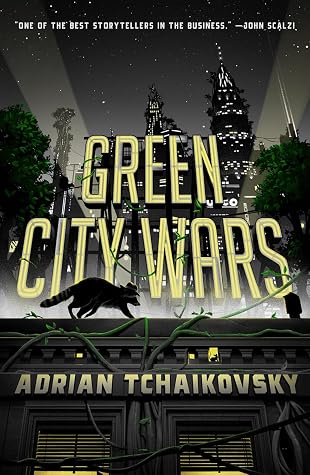
We’ve again got intelligent beings that aren’t humans, except this time they aren’t spiders (no more with the spindly creatures for a while, I beg you). And while this is scifi, it leans much more into the hardened gumshoe detective in a noir-y world, as promised on the front cover. Except that our detective is a racoon named Skotch, because of course he is.
In the world of this book, humans have decided to be a lot more environmentally friendly by switching from using polluting machinery for various city needs (e.g., garbage takeout) to using animals, specifically bioengineered animals known as Gehirner. It’s a very Henry Ford Company Village type system–animals can work within the confines of A Company, receive payment in buttons, and, most importantly, ensure a steady supply of Plangent, the drug that provides them with their humanoid intelligence. Or like Skotch, they can go freelance, and try to earn enough to buy Plangent off-market, knowing that they risk at any point falling off and becoming a ‘dumb’ animal, unable to regain their tentative scratched-out existence alongside but never part of humanity. Rule #1, after all, is to never be seen by the humans.
So Scotch, running low on planget, takes on that old canard: the one final/big job that’ll set him up for life. There’s a special mouse, you see, who has escaped the agriculture farms that feed the humans to the city, and needs to be tracked down and dealt with, if you know what I mean. But lots of people want this mouse, and Skotch is soon quite fed up being in the middle of a whole city’s worth of warring factions–a squirrel civil war, a human who feels that animals shouldn’t be second class citizens, a tortoise mob boss, rats, etc etc. Skotch doesn’t understand what’s going on with this mouse and quickly decides he can’t trust anyone until he himself comprehends the full picture.
There’s clearly a LOT of love and work that went into setting up the world, and that’s probably the reason why this ended up 3* for me–more than once, it feels like Tchaikovsky prioritizes side quests that advance the worldbuilding over the plot and given that it’s a mystery at the core of the story it suffers for the start and stop of momentum. All the normal tropes are here: a safe place that stops being safe, the character with ‘something to share that has to shared face to face’ ending up dead, characters telling you to your face that they will double cross you if you get in their way. And as a result, the ending is also a bit of a trope-fest. There’s only so much you can do within the confines of the genre, like with a sonnet, I guess???
