 I seem to do one of two things when writing a review. In the first instance, I try cobbling together my thoughts weeks or months after reading a book (a failed experiment that I keep trying), and unloading the errant thoughts I have while reading, or I write as I read and end up writing way more than any reasonable person wants to read. You can always tell the difference because one review is 5,000 words while the other is usually a short review dump of multiple books. Anyway, here’s a bunch of thoughts that are only tangentially related to the book I’m reviewing.
It’s interesting to me how the general American perception of Communism has changed so drastically in just a couple generations. For my parents, who were born in the 50s, Communism was a very real existential threat to society. Given how the 1940s and 1950s played out (Berlin, the Rosenbergs, the McCarthy trials, Korea…), and the rise of US capitalist hegemony, this seems a natural worldview. As a Millennial coming to adulthood in a post-9/11 world, though, these ideas are no longer as deeply ingrained in American society. Especially after Enron and the Subprime Mortgage crisis of 2007-08. “Communism”, as we call it, is (I think) increasingly seen as a just a flavor of authoritarianism that only approximately mirrors the things Karl Marx talked about. Socialism, if anything, seems to be going through a bit of a populist craze over the last decade, where a person’s bona fides seem heavily dependent on how far left they are publicly willing to go.
I’m not qualified to say any of what follows, so take it as the musings of a thoughtful person rather than the declaration of a knowledgeable one. But it seems to me to be an unintended consequence of US economic policy since the Great Depression.
The stock market collapsed in 1929 thanks to investors enriching their stock portfolios based largely on credit. Borrow from the bank to buy stocks, which then increase in value thanks to everyone throwing money at them, then sell the stocks to pay off the debt while pocketing some extra cash. It’s a great system….until something triggered a massive sell-off. The direct causes for the crash are contested, but when it finally happened in October, this led to those debts no longer being worth anything. In a system without an FDIC, people naturally feared their banks would run out of money (see: It’s a Wonderful Life), which would cause more people to withdraw money, in turn leading to the bank running out of money. The economic system – which is based on trust in the system itself – collapsed. The government didn’t have the tools to manipulate the dollar because it was backed by gold. Gold is a finite resource, so there wasn’t enough money in the system for the government to just nudge interest rates or “print more money”, which is what people so often criticize today. People – everyday people, not just investors – lost everything. Business owners who operationally relied on loans had to lay off their staff or close up shop. There was a commensurate fall in wages, which led to lowered prices, etc. It was a downward spiral brought about by a limited money supply and over-speculation on overvalued stocks.
Fundamentally, demand was broken. People couldn’t afford to eat, let alone buy radios and cars. The New Deal was inherently an attempt to give people the means to take part in the capitalist system, get back to work, and keep the assembly lines moving.
And it was fairly successful until the late 1930s, when budget cuts crept in and FDR took his foot off the economic accelerator. Money is the fuel that feeds the fire of capitalism, and there was about to be a massive influx of fuel into the economy in the form of WWII. Millions of Americans were gathered up by the war machine, and those left behind stepped in to fill the gaps in the assembly lines – including millions of women. Unemployment dropped. People were getting paid good money to do good work.
But they couldn’t buy anything. War time rationing left a population primed to spur growth, but not able to do so.
In 1946, the war was over and millions of Americans returned to a nation that was doing just fine. But the shift was gradual. Women returned to domesticity (not necessarily by choice, which eventually led to cultural forces of a different kind), and returning GIs gradually re-entered the workforce thanks to programs like the GI Bill. This allowed the production to shrink and shift away from wartime needs into people finally spending the money they’d earned during the war. People could now buy cars and radios and TVs and houses. And the US was basically untouched by the war, allowing manufacturers to rebuild Europe and Asia. The Great Depression was over. It was replaced by the explosion of the 1950s and early-1960s.
Since then, however, we’ve largely been dealing with supply side turmoil, not demand. The oil shocks of the 1970s. High inflation of the 1980s. The subprime mortgage crisis of 2008. COVID followed by the supply line collapse, high inflation and energy crises brought about by the Russian invasion of Ukraine and the Trump’s unconscionable attack on Iran. These are problems that aren’t solved by increasing demand. You can’t spend your way out of high food and gas prices. These are supply side issues, and they are a lot harder to solve in a society so oriented towards demand.
The economic lessons we’ve learned have so clearly demonstrated the need to spend money. Consume. Throw away your old stuff and buy the new and improved version. Get a new phone every year. Change your wardrobe every season. Buy, buy, buy. That’s America. That’s Capitalism.
And when things are going well, that rising tide of Capitalism raises all the vessels that rely on that consumption. But what happens to participatory consumers who can no longer afford a home? Or daycare? Or a fucking burger from McDonald’s? When cars cost $40k you have $80k in student debt while making $15/hr?
We’ve gone from Occupy Wall Street to Bernie Bros to Zohran Mamdani and a promised progressive wave. When government intervention no longer gets you out of the quagmire of mindless consumption, what is there left but a break from Capitalism? Especially given the looming climate crisis that’s increasingly difficult to ignore….but it also gets you the populism of the Tea Party and MAGA, as economic fear gives in to appeals to authoritarianism. America is a conservative nation, after all.
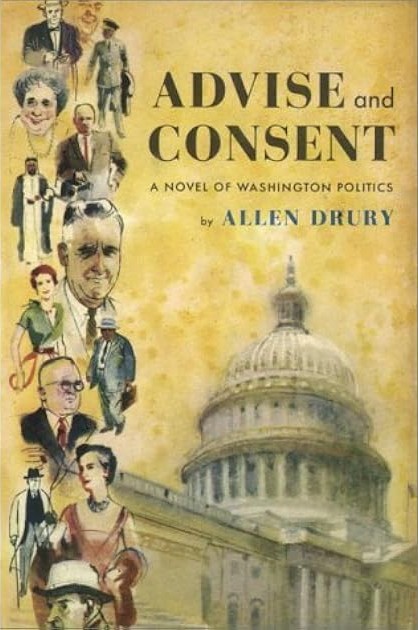
If you’ve read this far, you’re probably wondering what any of that has to do with this novel. Nothing. But, also, everything. It is background for how this novel can win the Pulitzer Prize for fiction in 1960, spend over 100 weeks at the top of the New York Times best-seller list, be adapted into a well-regarded 1962 film starring Henry Fonda….and end up spending almost two decades out of print by the time of the Obama administration. Drury’s Wikipedia page has him sitting on a couch next to Ronald Reagan. I would guess most people today haven’t even heard of him.
Allen Drury was the US Senate correspondent for UPI in the mid-1940s, detailing contentious disagreements between FDR and the Senate and witnessing the rise of Harry Truman. He intended to work in DC for about a year before returning to the West Coast to continue his career. But he stayed in DC for two decades, detailing the political machinations of big personalities in the capital. He ended up detailing the major players of the era in his diaries, which he would go on to publish in 1963 as A Senate Journal, and then spent the remainder of his life applying his observations and insight on the political machine of Washington onto fictional characters.
Drury was adamant that Advise and Consent was not a roman a clef. He was so vociferous in this opinion that he wrote a terse preface explicitly stating that this isn’t meant to be a stand-in for any real world event, or detail the actions and personalities of real world people, though it drew inspiration from all of the above. That said, this book clearly draws on a couple of prominent stories: the espionage and perjury trials of State Department employee Alger Hiss, and the blackmail and eventual suicide of US Senator Lester Hunt. Prior to reading this book, I recognized the name of the first, but could tell you nothing, and did not recognize the name of the second but could also tell you nothing. Interestingly, I was listening to an interview with Alger Hiss by Studs Turkel in 1973, and it begins with Turkel doing “man on the street” interviews with people about Hiss – most people (especially younger ones) were no better off. And those interviews were barely 20 years removed from from the hearings.
Alger Hiss was a lawyer and government official who entered the Justice Department in 1933 and served FDR through WWII and into the beginning of the Cold War under Harry Truman. So – the time Drury was in Washington reporting on the Senate. Hiss was at the Yalta Conference, which ensured that neither the Soviets nor the US would independently sign a peace treaty with Nazi Germany, and was instrumental in creating the UN, serving as Secretary-General of the UN Conference on International Organization, which created the UN Charter in 1945. Hiss was a star in the State Department likely being groomed for an eventual nomination to Secretary of State.
But in the 1930s he is alleged, by Whittaker Chambers, to have been a member of the Ware Group, a covert Communist group of economists, lawyers, and government officials organized under a Soviet spymaster going by the name of “J. Peter” (born in the Kingdom of Hungary as Sandor Goldberger) to study Marxist theory and doctrine, give money, and steal government documents. Or….it was a Marxist study group that sought Socialist solutions to the Great Depression. Initially led by Harold Ware, a Communist working in the New Deal government. When he died, Whittaker Chambers took over the Ware Group.
By the 1940s, Whittaker Chambers had become disillusioned with Communism, and became a fanatical Christian Conservative. He was also senior editor at Time magazine. At the height of his powers, in 1948, he was called before the House Committee on Un-American Activities to testify about Communism in America. He divulged names of Ware Group members, among whom was Alger Hiss. Thanks to the dogged pursuit of Richard Nixon, this eventually led to Hiss’s downfall and 4 year incarceration for perjury (the statute of limitations was up on espionage) in 1950. For the remainder of his life, Alger Hiss maintained his innocence. He died in 1996. Today, 30 years later, there are still debates over the veracity of the allegations against Hiss.
The Alger Hiss case has been an inflection point in American politics. Though largely forgotten today, he was at the center of debates around the left/right divide in America, McCarthyism, the Cold War, and Richard Nixon. He’s also been part of the political divide regarding homosexuality. Whittaker Chambers was a “reformed” homosexual, and this controversy was seen by some journalists as a kind of sub rosa fight between two homosexuals. Though Alger Hiss was straight, his stepson wasn’t – and was prevented from testifying in support of Alger Hiss by his stepfather for fear that outing himself so publicly would negatively impact the rest of his life. Former Congressman Barney Frank said the fallout due to the homosexual undertones of this story led to his not coming out while serving.
Another important case that is relevant to this book is that of Democratic Senator Lester Hunt of Wyoming. His son was arrested in 1953 for soliciting from an undercover male police officer in Lafayette Square, basically across the street from the White House. This was generally the kind of thing that police would allow families to handle privately, but Senate Republicans ended up finding out about it. Senators Styles Bridges (New Hampshire) and Herman Welker (Idaho) threatened Senator Hunt with making the story public if he didn’t immediately retire from the Senate and promise not to seek re-election in 1954. The Senate had a narrow Democratic majority at the time, and if Hunt retired, the Republican governor of Wyoming would be able to switch that seat.
Lester Hunt refused, and Republican Senators threatened Roy Blick of the Morals Division of the Washington Police Department with termination for failing to prosecute Lester Hunt Jr. This threat worked, and Lester Hunt attended his son’s trial, which ended in him having to pay a fine. Though the story was publicized, it wasn’t widely distributed by the newspapers.
The following year, Hunt announced his intentions to run for re-election, and polls showed strong support of him. This led to renewed efforts on the part of Senate Republicans to use his son’s arrest and prosecution against him. Eisenhower offered him a role in his administration, as a kind of compromise between his party and Hunt, I suppose. Hunt didn’t resign, and he didn’t accept Eisenhower’s offer, but he did announce that he wouldn’t run in the upcoming election. Joseph McCarthy ordered his staff to investigate “just plain wrong doing” by an unnamed senator. The following day, on June 19, 1954, Lester Hunt took his own life with a .22 caliber rifle while sitting at his desk in his Senate office.
All of these events went into this novel. The Ware Group, Whittaker Chambers, Alger Hiss, Joe McCarthy, Richard Nixon, Lester Hunt, the existential fight for economic supremacy in a post-war world.
It is a little perplexing to me that this novel won the Pulitzer Prize. It is, at times, captivating. But this isn’t A Game of Thrones. There are political machinations aplenty, but Drury is described by Thomas Mallon as the kind of “nonfiction-writer turned novelist who remains better at telling than showing”. And I think that’s the perfect encapsulation of this novel. He was a gifted writer, and had very strong political perceptions – but he isn’t writing a subtle novel, here. He’s ardently, passionately, anti-communist, and he thinks liberals are standing in the way of the US successfully opposing them.
I think this novel is less interesting as a 600 page political thriller than it is a snapshot of a time when American was trying to define itself as the righteous opposition to a political and economic system that increasingly appeared to be a viable contender for who would lead the world into the space age. Drury began writing this novel in earnest, after all, following the launch of Sputnik.
The United States was at it’s pinnacle when this book was written. This was before Vietnam, and the oil crisis, and….just so much of the world most of us have spent our entire lives dealing with. For someone coming out of WWII and looking poised to save the world from tyranny, this novel probably hits very different than it does an aging Millennial disinclined to see a problem with Socialism at a time when the US Bond market is sending up red flags, Corporations are consolidating across industries, and the price of diesel is encroaching on the Federal minimum wage.
