I continue my read-aloud campaign with The Secret Garden; in fact, we read the exact same copy that I read as a child. Charming!
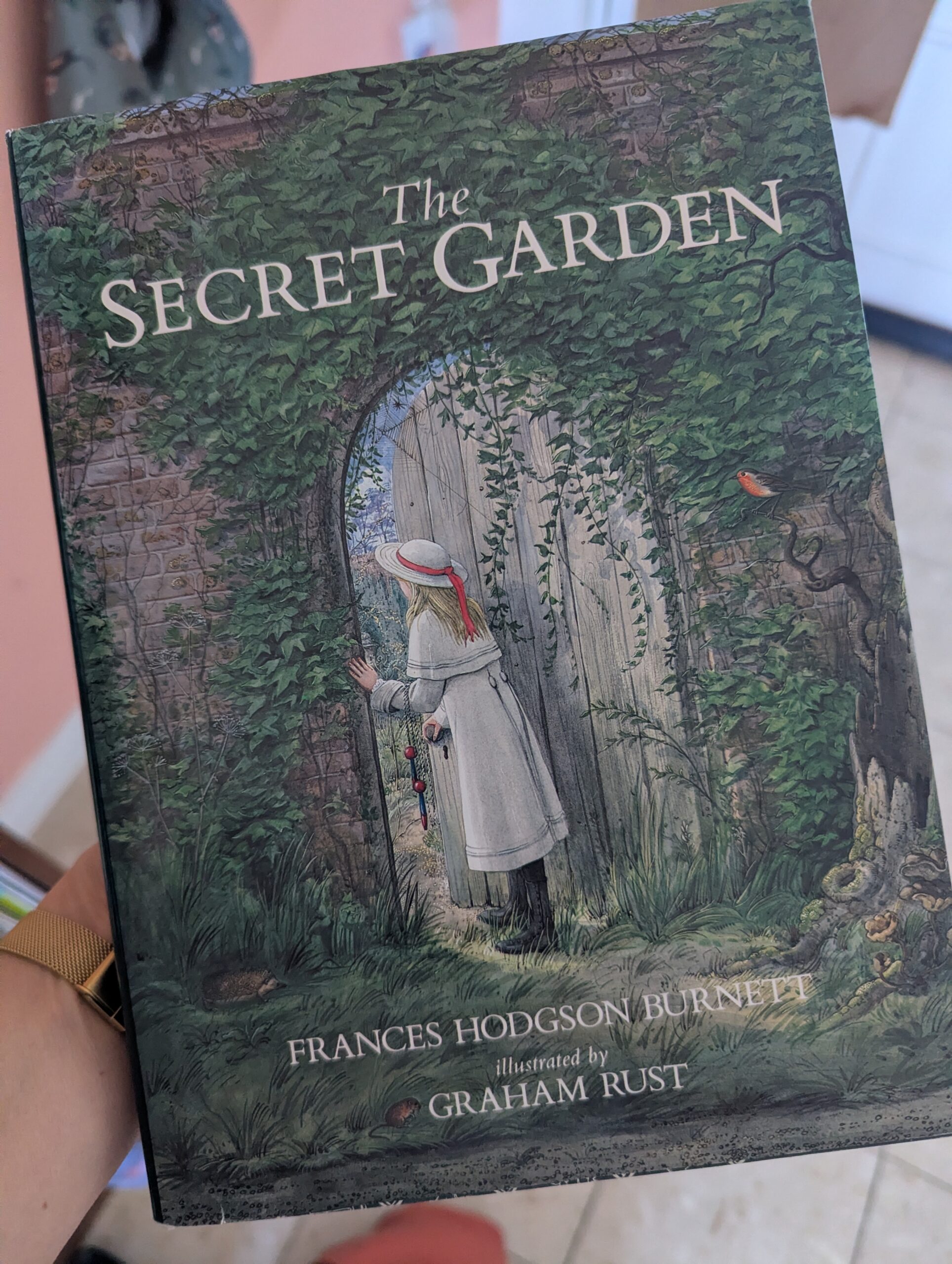
I’m sure you are familiar with the story: in 1900 or so, Mary Lennox is a sickly, neglected, self-centered, unpleasant 10-year-old in India; her British parents die of cholera. Not great! She is sent to her uncle at Misselthwaite Manor on the Yorkshire Moors, where she continues to be unpleasant and selfish until forced to GO OUTSIDE. This is, I am happy to report, something I can relate to intimately since at least 55 times a day during summer break I find myself saying, “Please stop picking fights and GO OUTSIDE.”
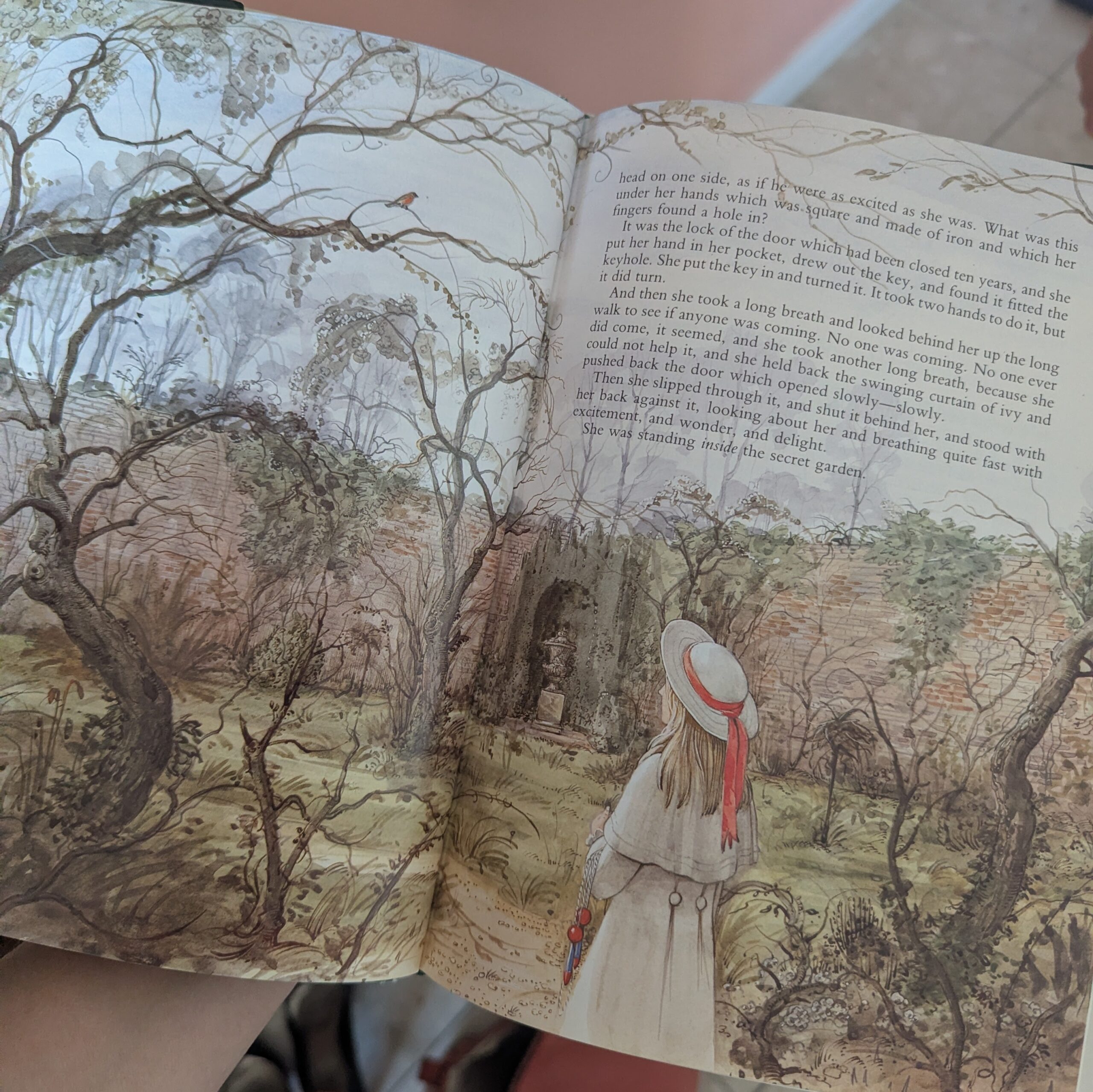
Anyway, it turns out she also has a 10-year-old cousin who is himself selfish and unpleasant, a small tyrant and hypochondriac; this immediately becomes an awkward but genuine companionship. Mary also meets Dickon, a gentle wild boy who spends his days charming animals, running around the moors, and tending plants. He introduces both spoiled children to the wonders of nature. The secret garden in question was Colin’s mother’s, and it was locked up and abandoned upon her death, at Colin’s birth. A robin (!) helps Mary find the key, and she gradually introduces her friends to the garden. With Dickon’s deep knowledge of the natural world, and Colin’s obstinate but naturally curious nature, along with some gentle guidance from select grown-ups (Dickon’s mother sending them baskets of baked potatoes to eat in the forest! Susan Sowerby, you are an inspiration.) the children tend the garden and turn into better versions of themselves.
As a read-aloud, this book is very good! The Hobbit remains our top read-aloud experience, so that’s our bar. The children rate this slightly lower; they loved the lush descriptions of the natural world, the flowers and their names, the winds and breezes, the smells and sounds. The action in this book is exceptionally gentle, but the suspense – when will she find the key? when will she tell Colin? when will Colin go outside? will Colin get over himself or nah? – is real. This is a book that takes its time, in a child-appropriate way, and I think it’s a wonderful companion to the more action-oriented kids novels of today. It uses language in a very different and luxurious way, and is neither apologetic or pedantic.
There were a few parts where I felt it was appropriate to pause for a discussion of Colonial British Attitudes, but I do think that this story holds up pretty well despite said Colonial British Attitudes. My kids (8 and 10) noted early on that Mary and her Yorkshire colleagues were “actually a little racist” when speaking about India, and this gave us a Teaching Opportunity to have a nice long chat about why that might be: how as a British child in India, she was being raised in a System which insulated her in important ways and constrained her ability to empathize; how her Indian nannies were likely constrained by that same System; how the Yorkshire neighbors probably relied on stereotypes due to inexperience and ignorance; how different a childhood in India might be for someone who had the opportunity to explore and pursue their natural curiosity; how this book, written in 1911, may have been just reporting current attitudes, right or wrong, and/or may have been condoning those attitudes. My kids had no problem with any of this and honestly most of the book is robins and forest picnics and old timey hypochondriacs and grumpy but gentle gardeners.
Kids liked it, I liked it, we give it a 4/5.
