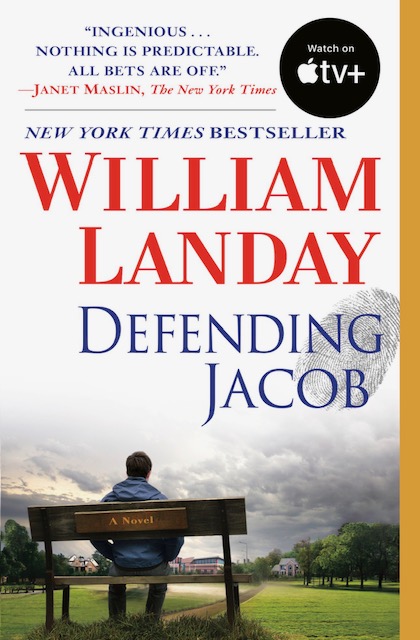
Bingo: Or. Father, the main character and narrator, tries throughout the book to convince the police that there is an option to his son as the killer.
A month or so ago I decided to go on a tear of 12 mystery/thriller books one after the other. I wanted a break from some of the heavier stuff I read. I found some lists of top thrillers and blindly bought a bunch. I also found some traditional mysteries at the used bookstore. Well, I’m starting to flag on the thrillers. They are getting aggressively similar, with the writing and plot often mediocre.
Defending Jacob is a two star read due to an insufferable narrator who, among many many other flaws, likes to creepily break down women’s bodies (more on that below). The plot is not tight enough and the twist ending is both abrupt and frustratingly open-ended.
But first, the plot. Andrew Barber is an assistant district attorney in a small Massachusetts suburb. A local middle school student is found in the park stabbed to death. Barber catches the case and works with the police to find a suspect. Eventually Barber’s son Jacob is charged, as the victim had bullied him severely and one of Jacob’s friends remembers him owning a knife. Later on a bloody fingerprint is connected to Jacob and it’s discovered he wrote a thinly disguised account of the murder and posted it on a web site.
Barber is taken off the case due to the involvement of his son, and another assistant district attorney takes over, Neal Logiudice. Logiudice zealously goes after Jacob and Barber finds himself in the position of fiercely defending Jacob. Barber is almost insufferable in his attempts to protect his son; he barrels over people, gets rid of possible evidence, and belligerently argues with everyone that his son is innocent. It’s true that the behavior is understandable, but the way Barber is depicted throughout the book makes him very unlikeable.
Another of Barber’s gross habits is constantly commenting on women’s appearance. The most egregious example is how Barber calls one of the judges at a hearing “Lard-Ass Rivera.” He doesn’t just mention it as a cruel nickname other members of the court have given her, he keeps referring to her as Lard-Ass throughout the entire court scene. He tags all her dialogue as coming from Lard-Ass Rivera, such as when the judge states: “Commonwealth,” Lard-Ass Rivera said, “I’ll hear you.” It’s totally gross, unfunny, misogynistic, and it’s not lost on the reader that this is the only person of color in the entire book. In other places Barber comments on a middle school girl’s “muffin top,” comments about a woman’s “little skirt of fat that circled her waist” and her “flat chest.” He describes his wife Laurie under the stress of the case, noting “her hair was getting grayer and sloppier, and her face was becoming crazed with lines like an old ceramic vase.” He barely describes the male characters, and when he does he doesn’t criticize them like the women. It just turned me off.
Interspersed with the story about Jacob’s arrest and trial, there are transcripts of a separate grand jury case, where Logiudice is questioning Barber in detail about Jacob’s court case among other things, but whether it’s past or present is hard to determine. The grand jury testimony is another mystery, because the reader doesn’t really understand how it fits in with the greater story. It was a pretty good way to ratchet up the mystery and tension.
As far as thrillers go, this one didn’t really stand out. Any number of popular writers could have written the book using the same plot and language. The ending was both unlikely and indeterminate, which I don’t enjoy in my thrillers; I like things definitively wrapped up.
