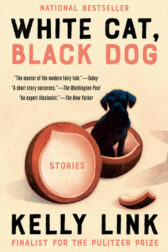
 Another great modern fairy tale collection, though very different than the Adelmann book. Link takes seven folktales and creates original, contemporary fairy tales inspired by them.
“The White Cat’s Divorce” is the opener, based on my beloved Madame d’Aulnoy’s “The White Cat” – and Link’s version is actually VERY close to the original story, except for its conclusion (which is a delicious twist). But her narration sounds very “21st century d’Aulnoy,” and the basic premise is the same. So it surprised me when over half of the fairy tales after didn’t have a lot to do with the source material they were inspired by.
Despite that, nearly all the stories are extremely good. “Prince Hat Underground” is another one that felt true to the essence of its inspiration, “East of the Sun, West of the Moon.” Funny and charming and irreverent, with a gay couple at its center.
“The White Road” is inspired by “The Musicians of Bremen,” but really only so much as it’s about a troupe of musicians/players, and there is a monster. Despite the loose inspo, the story is a riveting twist on a zombieish apocalypse.
“The Girl Who Did Not Know Fear” is probably the one that to me, has nothing to do with the fairy tale it riffs off of the most; it’s a purely original story that just happens to mention that fairy tale at one point (I can imagine an argument against my POV, where the main character of this book can’t know fear because in a way she IS fear (no spoilers), but to that hypothetical, I’d say what a college professor wrote on one of my Shakespeare interpretation papers: S-T-R-E-T-C-H!) Still, another very cool story with a fabulous twist!
“The Game of Smash and Recovery” is inspired by Hansel and Gretel and it’s the only one I couldn’t really get into, but I’ll try it again sometime.
“The Lady and the Fox” is a third fairly faithful retelling, this time of “Tam Lin.” Very romantic, very Time Traveler’s Wife, if the Time Traveler were actually a man cursed by the fae.
“Skinders Veil” is my favorite of the batch, inspired by “Snow White and Rose Red” – once again, the adaptation bears little resemblance to the fairy tale (see what I did there?) – you could use many other fairy tales as stand-ins for it – and I’d argue other fairy tales would make more sense with the larger themes of the story. But it would be spoilery of me to tell you which, and it’s a super moody, wry, mystical tale to be read with a blank slate!
I’ve adapted so many fairy tales, and my adaptations are almost always very close to the source – this was a cool challenge for me to read, to see how far you can imbue inspiration with your own ideas, and make me wonder how far I could push my own.
