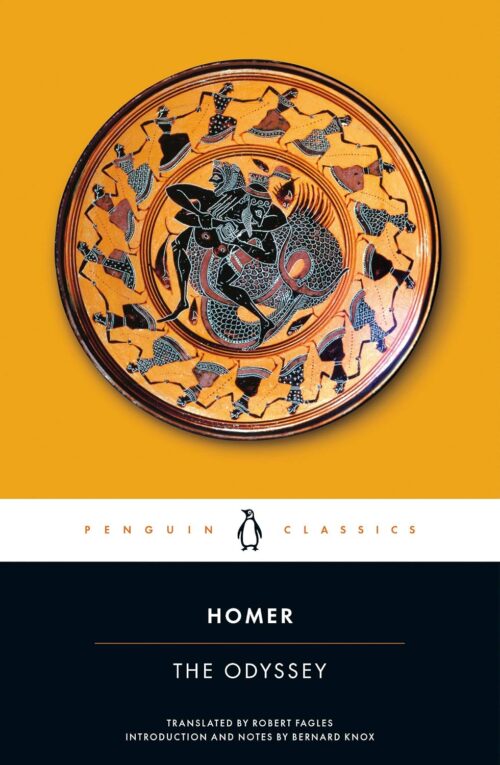
What could I possibly say abut The Odyssey? In advance of the impending release of Christopher Nolan’s film adaptation, I decided to re-familiarize myself with the story. Like most, I read at least part of Homer’s epic poem in a high school English class, but that was a long, long time ago.
All in all, I did not particularly find it a rewarding experience. How much of that comes down to my choice of translation is a question for others. I picked the Robert Fagles edition out of a perhaps misplaced confidence in Penguin Classics.
The thing about reading ancient texts is that you have to try to get yourself into the mindset that these are some of the earliest stories ever written and so of course, you have to make allowances. The characters are going to be more straightforwardly good or evil, the plots relatively simple and burden by moral lessons, and you really have to put up with the gods intervening at opportune moments.
The context of the movie release had an interesting effect on my reading, as I kept finding myself thinking, “well, there’s no way this is going to make it into the film.” Either because it’s way too boring, or because it would cause audiences to lose sympathy for the characters.
One way in which I may have failed the Odyssey is in my inability to read this as a poem. Frankly, with my interest flagging amid the constant reminders of Dawn’s rose-red fingers or the wine-dark coloring of the sea, I had a time not just racing through the content to get to the next plot point instead of savoring the language and poetic nature of the text.
Hopefully Christopher Nolan’s version won’t feel as long and repetitive.
