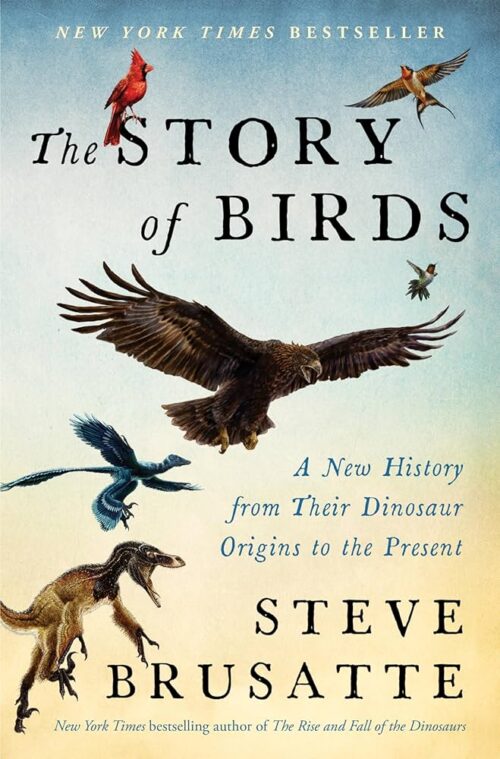
Like a lot of other elder millennials, I got very into birdwatching during the pandemic lockdowns, but I’ve always been interested in birds. I remember the first time I saw a bird and wanted to know more–a scarlet tanager at a nature center when I was a kid. In a time before cell phones, I couldn’t just look up what I’d seen. I had to describe it and my parents helped me find it in our Audubon’s Birds of North America guide. After that I spent hours paging through that guide. As a young adult I read a book about Australia that introduced me to the cassowary, a bird that has ever since been my favorite for being so weird, terrifying, and generally dinosaur-ish. And honestly, nothing made me as fascinated by birds as learning they were dinosaurs (one thing I loved about this book is it feels like Steve Brusatte is as excited about that fact as I am). When I travel, one of the things I get most excited about is the possibility that I might see birds I can’t see at home. I just love birds, man.
So it’s no surprise that I loved this book. The Story of Birds is an incredibly detailed history of how birds developed, from their feathers to their hollow bones to the unique organization of their skeletons that allows them to flap their wings enough to get airborne. It details how these features first showed up in dinosaurs, and theorizes how birds survived and adapted after an asteroid killed off almost everything on the planet. There’s a chapter on all the weird giant birds that went extinct over the years, like the demon ducks, the terror birds, the elephant birds, and the moas. There’s a chapter near the end about bird intelligence which confirmed all that stuff you’ve heard about crows being incredibly smart.
All of this was interesting, but the chapter on flightless birds was honestly one of the most fascinating things I’ve ever read. As evidenced by my love of cassowaries, I’m a big fan of flightless birds and this chapter was as hard to put down as any suspense novel. This book is full of interesting factoids, but for some reason the one that blew my mind was about how flightless birds became flightless–it’s not like every flightless bird alive today evolved from a common, flightless ancestor who never knew how to fly. Instead, different species gave up flying for different reasons (penguins, for example, sacrificed flying in order to be able to “fly” underwater). Ratites like emus and cassowaries gave it up because they didn’t have a large predator that they needed to be able to fly away from. Even today, scientists see evidence in a few species that they may be becoming flightless over time as they adapt to changes in their environment.
Like so many books about the natural sciences, this one ends on a real downer note when talking about the enormous number of songbirds that die each year from preventable causes (the number one killer being housecats). I just learned today that the current presidential administration in the U.S. has rolled back protections for endangered species in the U.S. by changing what it means to “harm” an endangered species. This will have devastating consequences for birds, among all the other species that will be harmed. We have such a fascination with birds, we’re so charmed by hummingbirds and penguins and parrots, yet we can’t get it together enough to make changes to protect them. Like so many things about life today, there’s a real “enjoy it while you can” feeling. Brusatte does his best to stay hopeful, and there is reason for that–after all, birds survived the asteroid that killed all the other dinosaurs, so hopefully they can survive us. If you like birds, I definitely recommend this book.
