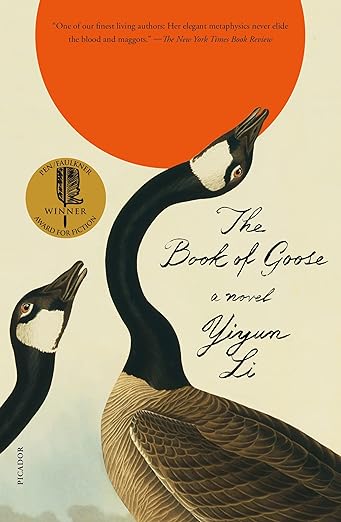
 Cbr18bingo – Bird
Almost as soon as I started reading The Book of Goose, I was reminded of Elena Ferrante’s Neapolitan Novels. Both Ferrante’s series and Li’s The Book of Goose feature impoverished girls living in post-WWII Europe. Both feature a friendship that can be competitive and dysfunctional. And both focus on the creative process of writing as well as the strains on childhood friendships when people grow up and apart. I loved Ferrante’s series. I liked this novel, but I might have liked it more if the author had invested more time in developing the relationship of the two main characters beyond just childhood.
Agnes and Fabienne are childhood friends growing up in a poor French village called St Remy that has not recovered from either WWI or WWII. Agnes is the conventional, smart girl who comes from a relatively stable family and who mostly follows the rules and goes along. The other girl, Fabienne, is a troublemaker from a broken home who is less educated but very intelligent. She is more creative and imaginative than Agnes, but she is also a bully. She spends her days herding the family’s livestock but is not above cruelty and violence toward animals or people. She seems incapable of pity. Agnes’ devotion to Fabienne is puzzling to both the reader and to Agnes. But I suppose it is Fabienne’s imagination and alpha energy that keeps Agnes in Fabienne’s thrall. One day, Fabienne decides that their new “game” will be to write stories. She will dictate them and Agnes, with her excellent handwriting, will write them down. Then, they will show them to the recently widowed local postmaster. The postmaster is very interested in the stories the girls write, although they tend to be macabre. And he seems very interested in Fabienne in particular. The stories come to the attention of a publisher in Paris, and Fabienne insists that only Agnes’ name appear as the author. While all three divide the profits from the sale of the book, Agnes Moreau comes to be known as the “girl author,” a prodigy worthy of attention. She is photographed for news articles and is offered a place at an English finishing school. Agnes wants none of this; she doesn’t want the attention and she doesn’t want to go away to school, but since Fabienne demands it, Agnes goes along. Agnes’ dream is for her and Fabienne to leave St Remy and live together in Paris, but Fabienne just laughs and shakes her head at Agnes’ dreams.
Agnes is miserable at Woodsway, the elite boarding school for girls in England. The headmistress clearly wants to use Agnes for her own literary ambitions, and the wealthy, worldly students know that Agnes, who is there on scholarship, is meant to attract other students to the school. She does not really belong there. Meanwhile, Fabienne writes to Agnes as Fabienne and separately as an alter ego called Jacques. Fabienne’s goals in writing to Agnes under two different names, as well as her urging Agnes to go to England are never clarified for me. Fabienne is aggravatingly enigmatic.
Ultimately, Agnes, who seemed such a sheep, finds that she can be as unkind and unthinking as Fabienne. The story essentially ends when Agnes returns to France, and the story jumps ahead a decade to show where the characters are now. I found it quite unsatisfying.
