 Very blatant spoilers for the previous books in the series here—be warned.
Has there ever been a book that you’ve really changed your mind about on re-read? The Annihilation Score is one of these. The Annihilation Score was a Laundry Files entry that was always going to face an uphill battle; not only was the first one to pivot away for Bob’s point of view, it also dealt with a a subject that perhaps does not gel terribly well with the subject of Eldritch horrors—superheroes. I mean, trust in Stross and all, but that was always going to be seen as a hard right turn.
The Annihilation Score starts just where the The Rhesus Chart leaves off—with the Laundry in chaos, Bob coming to terms with a sudden death and some scary new powers, and the realization that Bob and Mo were going to have to separate. Due to the nature of their work, Bob and Mo’s marriage had been under strain for a while, but what we, the reader may not have realized—and hell, Bob may not realized either—is that there was actually a third wheel in their relationship: Lecter.
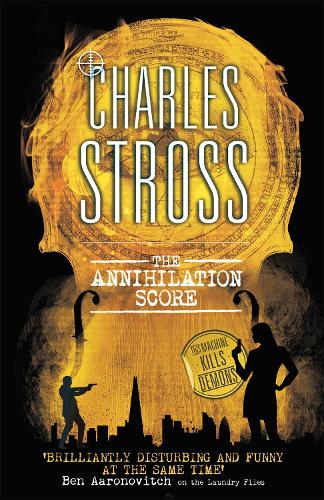
(Hannibal) Lecter is the nickname Mo has for her Erich Zahn original violin. Which we have seen her wield at the behest of The Laundry as their executioner—a job that has been taking its toll on her. THIS MACHINE KILLS DEMONS? Oh no, it can be used to kill so much more. And it’s not an inert object; as Bob pointed out at the the end of the The Rhesus Chart, Lecter has will, and is essentially a vampire. And after some of the aforementioned …changes Bob went through during the previous books climax, Lecter is no longer willing to just let Bob be. Lecter wants him dead.
So where do the superheroes come in? Case Nightmare Green is is on the edge and things are starting to get rough. Magic is becoming more common and scarily easy to access, and ordinary people are starting to develop powers. Considering how popular superhero were in the mid 2010’s, you shouldn’t be surprised that the general public start seeing these newly minted magic practitioners through this lens. Interesting, this is also the approach the Home Office is taking as well. Usually the Laundry would be more on top of these developments, but they’ve suffered a crushing, vampire-related blow just days previously and are not in a position to take the lead alone. So they’ve set up a new department to liaise with the government in the hopes that they can deal with the problem. And Mo is appointed by the Laundry to be the public director.
This is extremely shit for Mo in many ways; from what we’ve seen from previous books, she’s suffering from PTSD and has been teetering on the edge of burnout for far too long. She has also been a field agent for years, and an academic before that—this is not her wheelhouse. And the mass exposure of magic to the public is going to result in a clusterfuck, no matter how you look at it. But again, the Laundry has very recently lost a lot of staff in a very dramatic and traumatic fashion. There may not be enough capable staff left.
Joining her in this new department is Ramona Random, the Black Cauldron agent Bob worked with in The Jennifer Morgue and Mhari freaking Murphy, Bob’s vampire ex-girlfriend who Mo just had a very unpleasant encounter with just days previously. When I initially read this book, I couldn’t help but groan here—really? We’re dumping all this onto Mo? Right now? But it ends up being far better than you would think; these women all understand the seriousness of the task at hand and end up working together quite well. I get the impression that apart from her husband, Mo had virtually no co-workers she could turn to in times of crisis; now she has the start of a support network. Bob may have seen Mhari as nuts; Mo, even if she has some baggage with her, sees her potential.
Regarding Mo as an our narrator: this is one of the things where I perspective has changed slightly on re-read. Prior to this book, the impression that we got of Mo—at least from her husband—is that she is incredibly smart and capable, even when under duress. But the Mo we see here makes a number of bad decisions throughout the book that I initially found flummoxing. Now that I’ve re-read the books in quick succession, Mo’s actions makes a lot more sense; the Laundry has basically chewed her up and spat her out. Her violin is trying to mind-rape her. She’s in the throws of what seems to be a galloping mental breakdown. The fact that she makes mistakes should not be unexpected; a less capable person probably would have fallen apart at the seams much earlier.
Spoiler: And it doesn’t help that it looks like she was being set up as a Judas Goat.
Another thing that shocked me on my previous read was how self-centered Mo could be sometimes when it came to her relationship with Bob. I was often quite saddened when she was mentally quite dismissive or inconsiderate of her husband. But as I mentioned in my review of the Rhesus Chart with regards to Bob “Bob is aware his wife is upset, but he hasn’t really grasped how bad it is. But because of the incoming clusterfuck at work (KGB.2.YA and all)—he hasn’t got the mental energy to really deal with it head on” Just as he was too overwhelmed by the successive clusterfucks to dedicate enough time to his wife, Mo has been far too overwhelmed herself to give much grace to her husband. They both seem in dire need of some sick leave or long service leave, but now that the masquerade has finally been cracked beyond repair, that’s likely not happening. Also, going through the books, while Bob has previously gotten clearance for Mo’s assignments in order to support her, I don’t think they ever did the same for Mo; there’s little indication here that she fully understands TEAPOT, for example—which has been pretty central to Bob’s position since The Fuller Memorandum! I feel she would’ve been more compassionate towards Bob if she’d been let into the loop on his work and issues.
Spoiler: Despite all this, I’m still judging her for what went down with Jim. You gave yourself an anxiety spiral over the idea of your husband cheating one you and then decide to kiss another man? That’s starting to feel like projection, Mo.
Speaking of the near-shattered masquerade, my opinion on this is something that has not changed. I don’t mind how superheroes have been handled here; like the vampires of the previous book, they break the mould slightly with their Laundry-verse spin. (I feel for some of the new supers, especially “Officer Friendly.”) And there is some amusing social commentary made here. But I confess, I was not—and I guess I still am not—happy that in a world spun off from the horrors of Lovecraft, this was how the world was introduced to magic? Really? *
But on a more positive note, that ending? I did not guess that ending—and I am kicking myself for not being more clued in! Stross really knows how to pull together a third act.
For cbr18bingo, this one is Middle. Why? I am now in the middle of the mainline Laundry Files Books
