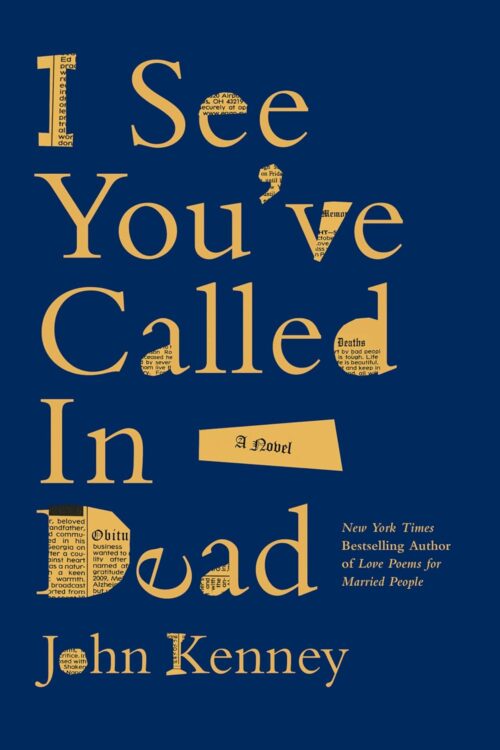
Bud Stanley was, somehow, the lead obituary writer at a New York newspaper until, in a bit of drunken foolishness exacerbated by his recent divorce, he decides to hack into the computer system at work and publish his own obituary. The paper wants to fire him immediately, but they are stymied by the (in my opinion, too cute by half) fact that the network now thinks Bud is dead and therefore can’t be fired. He is suspended until the glitch can be corrected.
When his former mother-in-law dies, Bud has a chance encounter with a woman he does not recognize. It turns out she’s a bit of an eccentric: an escapee from the corporate world who has started crashing the funerals of strangers to try to learn about living a good life. She invites Bud to accompany her on these off-putting excursions, and he, naturally, starts to fall for her charms.
In case a Manic Pixie Dream Girl wasn’t good enough to humanize Bud, author John Kenney also surrounds him with a disabled bestie in his roommate Tim – a paraplegic art critic, a gay work bestie who constantly chides Bud for being straight and white, and a precocious, perhaps autistic neighbor kid who, surprise surprise, has a way of putting things that cuts through the b.s. and helps Bud puts things in perspective.
As cliched and hacky as the supporting characters are, they are a necessary diversion from Bud, a man whose personality seems entirely encapsulated in his sardonic sense of humor. Bud is the kind of white guy protagonist even I, a white guy, thinks is best left in the pest: a non-specific “everyman” type with a job he doesn’t deserve and refuses to take seriously, with a bitch ex-wife who was clearly in the wrong, the aforementioned supporting cast all there to prop him up in his journey, and an unlikely ability to attract women.
This may just be my issue, but it really bothered me how neither the characters nor the author seemed to have any problem with crashing funerals. It made me so angry to think about strangers hanging out at my loved ones’ services, trying to glean some cheap life lessons from my grief. I was also put off by the climax of the novel, which used Tim, the disabled character, in a way that felt decidedly unearned by the rest of the novel.
And for one last complaint, I listened to the audiobook of this novel, and I disliked the reading done by narrator Sean Patrick Hopkins.
