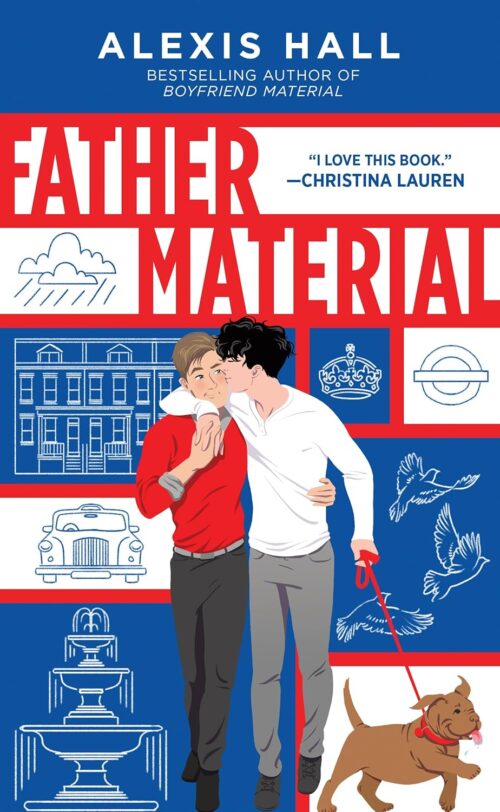
 Now that Luc and Oliver’s relationship has survived a few ups and downs – from fake dating to real dating, almost getting married – they figure it’s time for the next step: a dog. They get an adorable dog of indeterminate race named Spud, in spite of Oliver’s attempts to name him something elegant and statesque because Spud looks like a potato. Luc immediately feels inadequate in the face of Oliver’s immaculate preparation (reading a shitload of books and taking notes), his stern but loving discipline and his unwavering consistency – things that every puppy needs to grow into a well-behaved adult dog. But as their friends start having children left and right, Luc and Oliver feel that same itch. They soon decide that adoption and surrogacy aren’t for them, so they settle on foster care. Before long, a fourteen year old named Jasmine is dropped into their laps, and Luc and Oliver find that raising a teenager is nothing like raising a puppy.
I mean, duh.
This is the third and, I assume, last book in the London Calling series. I’m on the fence about Alexis Hall a lot of the time: I wasn’t a fan of Glitterland and I abjectly hated Murder Most Actual, but 10 Things That Didn’t Happen remains one of my favourite romance novels. I really enjoyed the first book in the series, Boyfriend Material and I likednotloved Husband Material, where I understood the point it was trying to make but that didn’t make it an enjoyable reading experience per sé. The third one, I’m happy to say, was mostly very good.
First of all, though it’s very funny, it doesn’t shy away from the bouts of depression and feelings of inadequacy that Luc suffers. Luc is good-looking and very witty, but feels like a perpetual fuck-up next to the somewhat humourless perfectionist that is Oliver. Oliver, as a lawyer, is a rigid workaholic who keeps everything supremely organised. At times it’s hard to see what the two see in each other; they’re very different and they don’t always complement each other. Still, Hall manages to make it look convincing.
The first third or so of the book drags a little and the tale of Luc and Oliver’s puppy rearing is somewhat repetitive. The book picks up when we meet Jasmine, who is delivered to Luc and Oliver in handcuffs. Oliver, whose father was a rigid disciplinarian, immediately clashes with the traumatised teenager while Luc intuitively knows to apply a bit more nuance. The fact that you don’t treat dogs and teenagers the same way is a genuine eye opener for Oliver.
All the same, it’s sweet book that sometimes rests on tropes a little too much, but Hall applies enough humour and gives his characters enough heart that by the time you get to the end, it’s hard not to get a little soppy.
