 Rating:
4 Stars
In a nutshell:
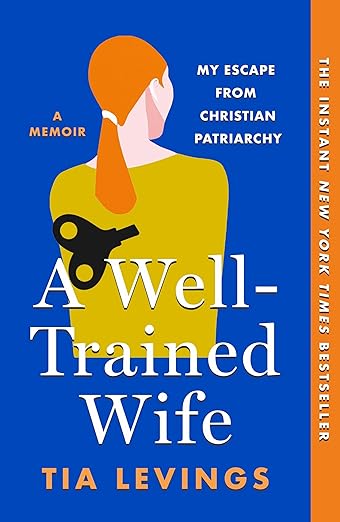
Tia Levings is raised very conservatively Christian, and ends up in a marriage governed by Christian dominionism and a controlling, abusive husband.
Best for:
Anyone interested into some insight into this type of religious control, from how it is ingrained in youth to how it controls the lives of women and children as they age.
Quote that made me think:
So much of this book had me shouting into the void, but the fact that her husband forced her to write this out just about sent me over the edge: “I will not accuse my husband of domestic violence due to Christian discipline.”
Why I chose it:
I have some strong opinions about religious control of people, and I was interested to learn about the experience of leaving one of the most insidious sects.
Review:
I will be clear up front that I think it is wrong to push religion onto small children. Obviously this is based on my own life experience of not really being raised with any religion, and I’m sure there are loads of benefits to thinking there is something bigger out there than just the individual. But it seems more and more that the focus is on obedience, not love and peace. I think it is messed up to tell a child they’ll go to hell if they don’t believe in a specific deity, and I think much of religion – though not all of it, and certainly not to the degree discussed in this book – is used to control women and children and allow men to act out fantasies of domination.
Do you ever read something and think ‘holy shit, WHAT did I just read’? Well this book is basically paragraph after paragraph of absolutely wild, unhinged, deeply disturbing, misogynistic crap. Not the author’s writing, but the propaganda that is forced into her brain from a young age. When, as a child, a classmate’s mother dies of cancer, church leaders say that cancer exists because of sin in the world, and kids shouldn’t be sad about a dead parent because they’ll see them again in heaven.
Author Levings’s writing feels honest, if that makes sense, And she clearly has conflicted feelings for her entire life, recognizing when something she’s taught seems to be wrong. One thing that stuck out for me is as a teen she’s talking to a friend about marriage, and mentions that she hopes her future husband understands that she won’t want to have sex all the time. And instead of responding with ‘of course, we aren’t sex slaves,’ the friend instead says that women must always be sexually available to their husbands and there is no such thing as rape in marriage.
Honestly it gets worse from there. The red flags with her boyfriend and eventual husband Alan are there from the very start. They even go to mandated premarital counseling and are told they are incompatible. Alan clearly believes he is owed an obedient and submissive wife, and acts accordingly. At one point they switch to an even more conservative church, and she is required to accept Christian discipline – he basically abuses her to ‘correct’ things she does wrong. And she has to call him My Lord.
IT’S SO GROSS.
But it isn’t just the marital relationship – the ‘guidance’ she is given about how to raise her children is horrifying. For example, she is encouraged to do blanket training with her infant, where if the child tries to crawl off the blanket without permission, they are physically disciplined so they learn not to do anything ‘wrong.’ And it’s all under the cover of ensuring their salvation.
The inner torment Leving deals with is heartbreaking. She knows there is something wrong, she knows she deserves better, but she’s been indoctrinated with the literal fear of God. That’s a hard thing to work through. But she does! And I appreciate that this happens about 3/4 of the way through the book, so we also get to learn about how she recovers from her marriage, addresses her CPTSD and religious trauma, and builds a new life,
Would I recommend it to its target audience:
Yes
