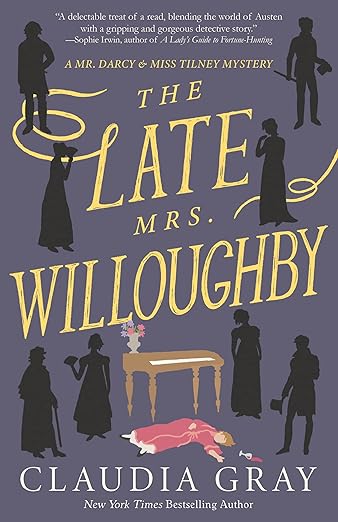
 My local bookstore recently had a table full of Claudia Gray’s Jane Austen-based detective series on sale, so I picked up a couple, not realizing that I was starting with books 2 and 3. That’s a little bit of a shame, and I might circle back around to the first book eventually, but I still find this introduction to Gray’s series most entertaining. Gray has taken Austen’s best known and beloved characters from across several of her novels and created extended families for them, including children who solve murder mysteries.
Mr. Darcy and Miss Tilney are Jonathan Darcy, son of Pride and Prejudice’s Lizzie and Darcy, and Juliet Tilney, daughter of Catherine Morland and Henry Tilney of Northanger Abbey. In The Late Mrs. Willoughby, Darcy and Juliet are meeting up for the second time, having solved the murder of Wickham in Gray’s first book in the series. Chance brings them together again when Marianne Brandon (Sense and Sensibility) invites her friend Juliet to stay with her at Delaford, the manor that she and Colonel Brandon have in the village called Barton. Meanwhile neighbor John Willoughby (also of S&S) invites several of his old schoolmates, including Darcy, to stay at his estate. At a dinner party in which all are awkwardly in attendance, Willoughby’s wife dies quite suddenly and gruesomely. It doesn’t take long for rumors of murder to spread throughout the village, with special suspicion falling on Marianne Brandon due to her history with Willoughby and due to events that occurred in book 1 of the series. Yet it seems that others might have had their own reasons to target Mrs. Willoughby. And it seems equally possible that Mrs. Willoughby was not the murderer’s intended target.
A constant theme in this novel is frustrated love, whether it be from one person’s dishonesty and faithlessness or as the result of financial circumstances. Readers know that in Sense and Sensibility, Marianne expected to become engaged to Willoughby but his financial circumstances meant he could not marry her due to her lack of fortune. Gray references other such circumstances from Austen’s other novels as well as creating her own such situations for her characters. The qualities that make for a happy marriage as well as those that guarantee misery are front and center.
One of the interesting aspects of the series is the character Jonathan Darcy, who seems to be on the autism spectrum. Jonathan has trouble looking people in the eye, is a literal thinker, is socially awkward and misreads cues, and has sensory sensitivities. We also learn that he does not particularly care for his “friends” but has gone to Willoughby’s because he was invited and it made his parents happy that he was doing something social. In school, Willoughby and the others bullied Jonathan and gave him the nickname Thumps because of one of his behaviors. Jonathan works hard to try to be “normal” but he can be quite blunt and misses nuance. Miss Tilney is one person who values him for who he is. She recognizes his intelligence and decency and values his friendship. The question is, are they falling in love?
This was an enjoyable and quick read. I am an Austen lover and it’s clear that Claudia Gray is, too. I loved the way she incorporated known characters (the Dashwood clan, Mrs. Jennings, the Ferrars) into the story and also developed new characters out of her own imagination. She shows great respect for the original novels and has crafted a fine murder mystery to boot. I will probably read the others in the series. They are a nice diversion from some of the heavier stuff I have been reading lately.
