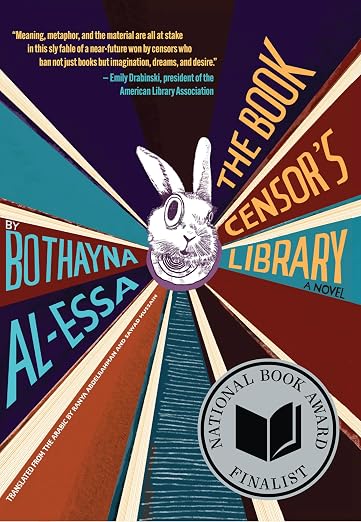
 This is a wonderful book about imagination, books, libraries, and censorship. It’s a love song to some literary classics and a picture of a dystopian not-too-distant future where most literature is banned and burned. How far would you go to preserve the ideas and literary creations that have formed us? What is worth saving? What price would you pay?
The characters in this book have no names; rather they have titles or descriptors. The main character is the Book Censor, a man who wants only to be promoted to inspector so he can go to book stores and remove contraband. As it is, he works in an office with seven other censors, reading books and flagging them for violations of the political order. The Book Censor lives in a post-revolutionary world where most technology has been banned and imagination is not just discouraged but criminalized. The Book Censor has no interest in bucking the social and political order, but a couple of things will send him off track. First, his young daughter is showing signs of imagination; she likes to dress up, talk to imaginary friends and make up stories. In this world, such children can be taken from their parents and sent to detention centers for reprogramming. This can destroy the child’s spirit if not their body. Second, the Book Censor, being ambitious, puts himself forward to read a new edition of a classic novel, Zorba the Greek. His boss discourages it but allows him to continue, reminding him to always focus on the superficial; don’t think too much about what you are reading and do not ever indulge in interpretation. But the Book Censor finds himself falling for Zorba and soon comes into contact with a former censor known as the Secretary. The Secretary was nearly imprisoned for falling in love with reading and smuggling books out for his personal enjoyment. The Department Head gave him a reprieve but keeps him close by to observe him. The Book Censor doesn’t much care for the Secretary but then his imaginative little daughter and the Secretary become close, and the real problems begin for the Censor.
Soon he learns about an underground group of book lovers who try to save and preserve as many classics as they can. The Book Censor gets drawn deeper and deeper into this world, indulging in his growing love of reading. The descriptions of books and their hold on him will be familiar to all avid readers, as will the Book Censor’s overwhelming awe and wonder when he visits the Labyrinth, the book depository for all the books that will eventually be burned. The obsession with books and the feeling that literary characters are real will also hit home for many.
This is a novel about and for book lovers, but I don’t want to downplay the dystopian nature of it. The danger for the Book Censor and for those he loves is real. I loved the way Bothayna Al-Essa worked elements of Zorba, Alice in Wonderland, 1984, Pinocchio and Fahrenheit 451 into this story, and created an end to the story that is both a warning about censorship and a celebration of imagination. She is a Kuwaiti writer and has written many children’s books in addition to novels. This translation by Ranya Abdelrahman and Sawad Hussain was named a National Book Award Finalist for translated literature in 2024.
