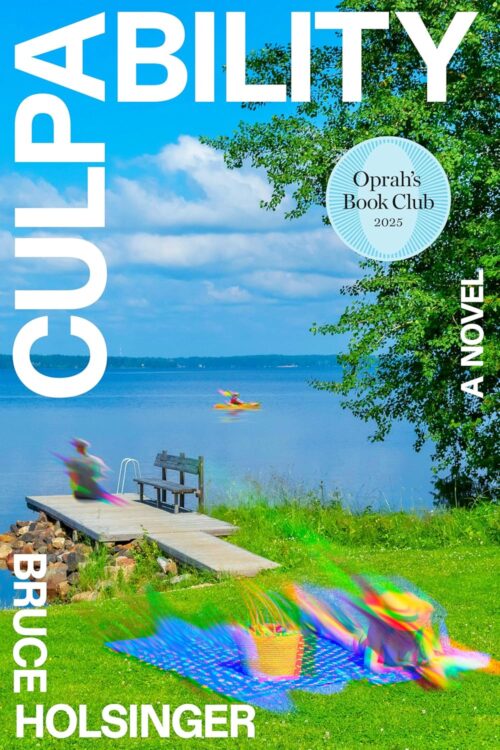
The five-member Cassidy-Shaw family is on their way to eldest son Charlie’s last high school lacrosse tournament when their AI-assisted minivan becomes involved in a fatal car accident with another vehicle. Both fatalities are in the other vehicle, but the Cassidy-Shaws are far from unscathed.
The accident prompts one big question: who is responsible? Charlie was technically in the driver’s seat, but the AI system was in control, theoretically. Charlie’s father Noah, a corporate lawyer, was sitting up front with him, but he was busy drafting a motion and not monitoring his soon the way he was supposed to. For reasons that author Bruce Holsinger will eventually make clear, all five of the Cassidy-Shaws feel some responsibility for the crash.
The novel is narrated by Noah Cassidy-Shaw, who frets about his son’s legal culpability as well as his own. He also begins to notice his wife Lorelei and older daughter Alice drawing away from him, Lorelei into the world of a tech billionaire impressed with her work on AI and Alice into her phone, where she has found a confidant in a friendly LLM.
Holsinger seems really fascinated with the ethical implications associated with AI and other technologies that are infiltrating our daily lives in big and small ways, but he struggles to effectively dramatize them in a way that will stick with readers. The philosophical debate over whether Charlie is at fault for the accident may be intriguing, but Charlie himself is a cipher, a placeholder in the debate much like the hypothetical operator at the wheel in the famous trolley problem. The other Cassidy-Shaws don’t fare much better. Noah mostly just seems insecure about his intellect (a running theme is that Lorelei’s family are all geniuses, including her sister Julie, a much more successful lawyer than Noah) and anxious about his precarious situation. The particulars of his job, his interests, or what he thinks are surprisingly scant in a novel where he serves as the narrator. Lorelei is a genius obsessed with trying to live ethically, which is a bit one-note but does at least tie into the plot in a dramatically satisfying manner. Alice is essentially just a generic TV teenager, moody and sullen, while youngest daughter Izzy has no personality beyond her hero-worship of her brother. And as for the characters outside the family? Forget it.
Culpability has some impressive tricks up its sleeve, with a couple of big reveals that reframe the preceding events in thought-provoking ways, but even as those revelations come out, the reader is cognizant that Holsinger is playing a shell game with them, taunting them with the existence of “secrets” instead of laying out the story in a natural way. Holsinger also drags out the ending to an absurd degree, seemingly not recognizing that the first of his novel’s several endings is the best.
Though the thorny issues on display could make Culpability a fruitful choice for a book club, it ultimately falls short as a work of art as it is too transparently an attempt to transpose ethical dilemmas into a work of fiction.
