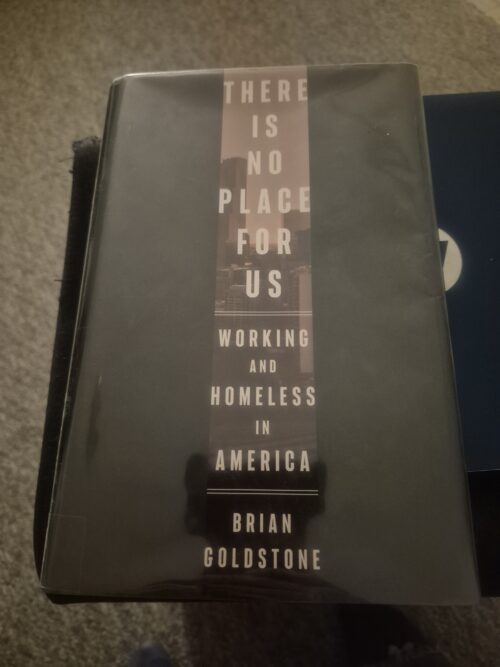
 The freshly minted Pulitzer Prize winner for best nonfiction, There Is No Place for Us: Homelessness in America, is absolutely heartbreaking and terrifying–but I couldn’t look away from the text for the 24 hours it took me to read Brian Gladstone’s book.
The scope is simultaneously wide and narrow. Gladstone follows five families of various shapes and sizes in Atlanta in the early 2020s. Each of these families have their own shapes, sizes, textures, and personal challenges, but they all have one thing in common: they are desperately struggling to maintain stable housing. This is Gladstone’s primary argument: statistics concerning the unhoused population are wildly underestimated because they don’t account for the people who are literally one crisis away from losing roofs over their heads. The book covers entire families who are rooming with friends, staying in their cars, sleeping on floors, spending nights in storage units, moving from hotel to hotel, and surviving squalid and dangerous living conditions–but because they don’t live on the streets or in a shelter, they are not considered homeless. Gladstone’s novelistic approach to his subjects’ lives shows just how dangerous and despairing it is to be one of the working homeless. All of his subjects work 7, 8, 10 hours a day, often while caring for multiple children, and they simply cannot make ends meet, let alone navigate the treacherous landscape of finding a home. The novel captures a Kafkaesque horror show of extortionate application fees, landlord scams, vouchers that are never honored, social programs that require prohibitive demands and fees, and capricious rents and evictions.
One criticism of There Is No Place for Us is that the details of the stories become confusing. Gladstone interweaves these stories in order to illustrate the way that all of these individuals’ unique stories ultimately follow the same trajectory in the search for housing: equilibrium, storm, possibility, and rupture. While I, when I started reading, might initially have forgotten the details of one story or another, I quickly realized which was which. And the deeper I got into the book, the easier it was to differentiate the stories and the characters. Gladstone’s empathy for his subject shines through–even when he is candidly describing one mother’s descent into alcoholism, he makes clear that her self-loathing about not being able to provide a stable home for her children is at the heart of her actions.
Others have criticized There Is No Place for Us for its sole focus on Atlanta. This is a really silly objection–of course there are working homeless in every metro area in the country. Gladstone’s choice of Atlanta is a clear because of the city’s status as one of the fastest-growing cities in the Southeast–and one of the most rapidly gentrifying. Atlanta is majority minority, but the proportion of new residents who are white has increased with Atlanta’s tech and entertainment booms. In Atlanta, like anywhere else, the housing crisis disproportionately impacts its most vulnerable. COVID also has had a devastating impact, as Georgia’s Republican government did not expand Medicaid coverage.
This book is so readable and engaging while being an absolutely devastating indictment of inequality in the United States. How have we as a society decided that a basic necessity like stable, affordable housing is now a luxury that is out of reach for so many?
Make a Place for This One
There Is No Place for Us: Working and Homeless in America by Brian Gladstone
