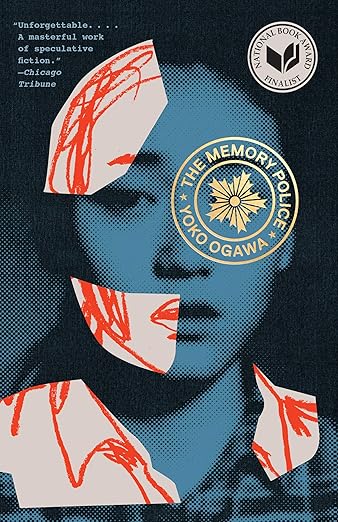
 The Memory Police is an unsettling novel. The descriptions I read in advance made it sound a bit like 1984 or Fahrenheit 451. It is a dystopian novel, and it does involve the authoritarian suppression of knowledge and personal freedom, but while I think of 1984 and Fahrenheit 451 as “political” science fiction, The Memory Police is not exactly that. The most disturbing acts of suppression in The Memory Police come from within the people themselves.
The story is set on an island where some authority determines what things need to be eliminated. The main character, an unnamed woman who is a novelist, describes such events, how she might wake up one morning and realize something is different, only to discover that something (maybe as small as candies, maybe as large as boats) are now gone. She and her neighbors gather outside and freely destroy whatever object has been eliminated if it is something they own. They don’t question or resist, they don’t cry or get angry. They see no point because they have dealt with loss before and everything turns out fine. Moreover, once an object has been eliminated, people don’t just quickly forget about it; they are genuinely unable to remember it. Amongst this population, there are some rare people whose memories are strong, who never forget. The Memory Police not only make sure that disappeared things stay disappeared, but they also try to find and eliminate those who retain memories.
The main character, the writer, has known a couple of people who retained memories. One was her mother, a sculptor who found ingenious ways to save items that were supposed to be gone. The other is her editor, called R, who ends up hiding in a secret room of the writer’s home with the help of an old family friend of hers. The three care deeply about one another, but one can sense R’s frustration with the writer and the old man’s acceptance of a completely unacceptable world, a world without memories. He tries to help them remember forgotten things, and these passages are both sad and frustrating to read.
Throughout this novel, the main character is writing a novel herself, something R encourages and supports. The novel she is writing is a very strange one about a typist and her teacher that I initially did not understand or appreciate. It made sense to me at the end, and frankly, it’s one of the saddest things I have read in a while.
Overall, I found it a struggle to get through this novel, perhaps because, like R, I was so frustrated with the apathy of the main characters. In other dystopian novels, there are rebels, people who fight injustice, but we don’t get that with The Memory Police. Then again, we do live in a world filled with people just like the people of this unnamed island, people who seem resigned to the horrors that are visited upon the world every day, who don’t question authority or imagine that they could or should push back. One of the other takes I have seen on this novel is that it could be seen as a story of dementia/alzheimers and how it slowly takes away all the things that made the person we know and love that person. In some ways I find this a more interesting way of reading The Memory Police than as a work of dystopian fiction.
