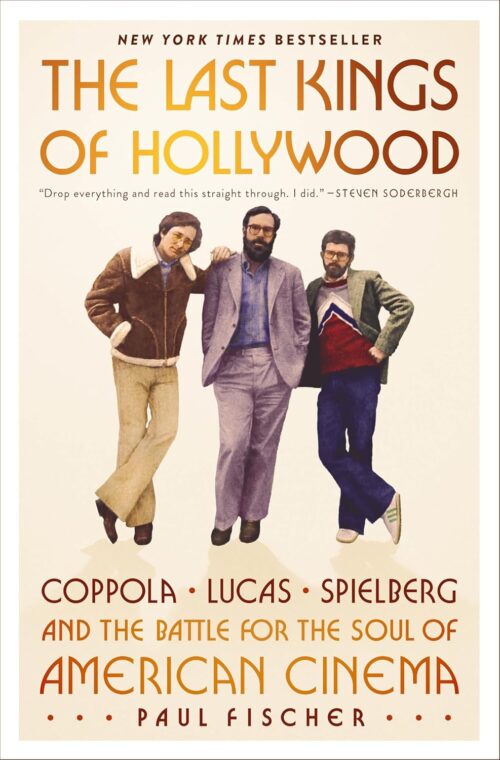
The story of how Francis Ford Coppola, George Lucas, and Steven Spielberg met, befriended each other, and worked in frequently close collaboration as they took over Hollywood in the 1970s is a subject tailor-made for a great book. Paul Fischer’s The Last Kings of Hollywood, however, is not that book. While he studiously chronicles the events of the time period, he fails to capture or transmit any excitement for it. You know that line from Good Will Hunting about an education you could have got “for $1.50 in late fees from the public library”? There’s very little in this book you couldn’t pick up after hanging out on Film Twitter for a few months.
For the most part, these are well-worn chestnuts, albeit about some of the best movies ever made. Did you know the studio wanted Al Pacino fired from The Godfather? Or that the shark in Jaws broke down a lot? Or that Apocalypse Now was a difficult shoot? How about that Tom Selleck was originally cast as Indiana Jones, but had to drop out because the Magnum, P.I. pilot got picked up as a series at CBS? If you’re anything resembling a film nerd, you almost certainly know these stories, yet each is presented here with the “gee-whiz” awe of a new revelation.
Fischer has the most to offer on the aspects of the film industry that I care least about: how much money was being made or spent and who was sleeping with who. Coppola’s prodigious, sustained infidelity is stunning in its audacity, but I’m not sure I needed so much detail on it. Slightly more intriguing is the volatile nature of the friendship between Coppola and Lucas, who clashed over which of them would get to direct Apocalypse Now. Fischer convincingly presents them as diametrically-opposed opposites, with Lucas the careful, cautious technician and Coppola the free-spending, deep-feeling storyteller. Spielberg, despite working directly with Lucas on Raiders of the Lost Ark, shockingly takes a bit of a bag seat in the book, receiving only slightly more attention than some filmmakers not cited in the title, like Martin Scorsese or John Milius.
Short on new detail and penetrating insight, The Last Kings of Hollywood might suffice as an entry-point for the aspiring film snob, but people with an abiding interest in the medium may find it an uneventful read.
