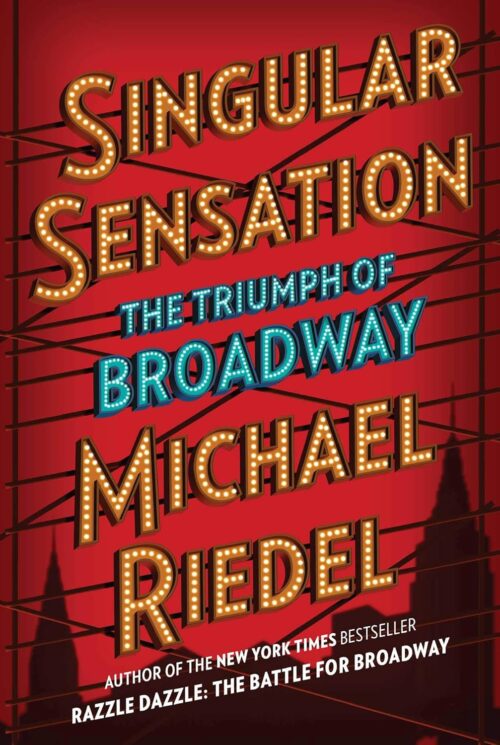
In his previous book, Razzle Dazzle, Michael Riedel chronicled Broadway history from the 1960s through the ’90s, mainly through the lens of the Shubert Organization and the two men who took control of it in order to save the company and their industry as a whole, Gerald Schoenfeld and Bernard Jacobs. Financially, Broadway was in a good place at the end of the book, buoyed by the British mega-musicals, like Cats, Les Misérables, and The Phantom of the Opera. There were problems visible on the horizon, however, especially in the grumbling of American theater professionals who wondered if this British Invasion of Broadway was crowding out their work.
Singular Sensation: The Triumph of Broadway tells the story of how new kinds of shows began to assert themselves, but it starts with the show that foretold the end of the Brits’ dominance. Andrew Lloyd Webber’s Sunset Boulevard is beloved by many, and its original Broadway production earned Glenn Close a well-deserved Tony Award, but the backstage drama, cost overruns and even lawsuits deeply cut into its revenues, and despite selling out most of its run, the show closed at a staggering loss. Lloyd Webber’s next show, Aspects of Love, was critically reviled and with that, his seemingly unstoppable run of success was definitively over.
Riedel takes a more show-by-show approach in this book than he did in Razzle Dazzle. Though Singular Sensation does profile emergent producers and production companies like Rocco Landesman of Jujamcyn and the controversial Garth Dravinsky of Livent, far more time is dedicated to the development of the era’s big hits, starting with RENT. Riedel extensively profiles composer Jonathan Larson, following him throughout his struggle to get his works produced while still working as a waiter to make ends meet. RENT took a tremendous amount of effort to get to Broadway, with its cast of unknowns and its shoestring budget for its pre-Broadway showcases. And then of course, comes the tragedy of Jonathan Larson’s death, just as the show was finally about to open on Broadway.
Riedel does a great job capturing the phenomenon that RENT became, especially the way it drew people to theater that had never attended before. Something I did not know was that the show inspired the first Broadway ticket lottery, as the producers knew they needed to do something to allow young people without much discretionary spending money to see the show. With its incorporation of pop and rock music and its shaggy-dog styling, RENT was the absolute antithesis of the British mega-musicals.
Other shows that get close examinations are Disney’s The Lion King, the revival of Chicago, Tony Kushner’s epic two-part Angels in America, Ragtime, Titanic, and Edward Albee’s huge comeback hit Three Tall Women. Riedel discusses the financially lucrative trend for lavish revivals of beloved standards like Guys and Dolls, and the beginnings of the model for profit-sharing with big Hollywood stars like Nicole Kidman and Julia Roberts to get them to commit to short-run productions of non-musical plays.
The book closes with one more mega-hit, Mel Brooks’s The Producers. With stars Nathan Lane and Matthew Broderick, the show coasted to a record number of Tony wins, and it’s status as a must-see cultural phenomenon was instrumental in getting people to come back to Broadway in the aftermath of September 11, 2001. Because after all, the show must go on.
Singular Sensation is a bit more scattershot than its predecessor, with a central thesis less supported by the evidence presented, but that will hardly matter to most theater fans, who will enjoy the backstage accounts of some of their favorite shows more than enough to compensate.
