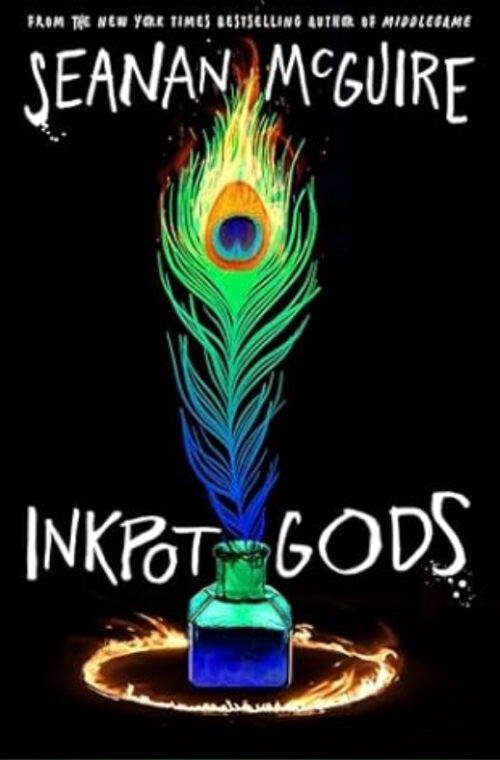
I have read most of what Seanan McGuire has written, including under her pen name Mira Grant, so of course I jumped at Netgalley’s offer of an ARC of Inkpot Gods, the fourth of her Alchemical Journeys novels (she also did a spin off of this series, writing some of the often referenced children’s books that alchemist Asphodel Deborah Baker used to share her studies in plain sight). As far as I am tracking, this series is intended to be five books total, and this one definitely sets it up for the endgame.
Of all McGuire’s series, this is the one that has the most complex and philosophical premise, dealing with personifications of concepts, and yet it also encapsulates so much of her previous work and the themes she has been exploring. It’s her most ambitious work, bringing together all the different genres and works she has previously published (and is still releasing): the found family of her urban fantasy series, the body horror of her Mira Grant series, and the otherworldliness of her Wayward Children novellas.
When this series initially came out, I wasn’t entirely sure where McGuire would take this. Middlegame easily could have been a stand alone novel. With the second novel, it felt like maybe it was going to be a series in a shared world with appearances from already introduced characters, as Seasonal Fears focused on the manifestation of seasons with the new crowning of the Winter King and Summer Queen. In Tidal Creatures, the first part felt like it was expanding the world with that same route, introducing the pantheon of moon gods manifested in humans, until very much pulling the Middlegame characters back into the narrative in a main role.
Inkpot Gods, the fourth novel, is the one that is most clearly a direct sequel from the beginning of the story. Like the others, a new character is introduced early on, someone else connected to the magical world, and as a reader, I couldn’t wait to see what new aspect the novel would explore with Lilianne, only to discover that she is a young, self trained alchemist. As a non-magical, normal human born into a family of supernatural beings (manifestations of the seasons), Lilianne has always felt something was missing, and views alchemy as her way to be part of it all, despite her family’s dislike and fear of alchemists. Based on everything we have learned in the series so far, they are absolutely correct to feel that way.
She is in Berkeley to study, to discover the Doctrine (Roger and Dodger), and to learn more about alchemy, and it takes only a few pages for her to unknowingly cross paths with Smita, one of their close friends and roommates. There are some entertaining moments later where Lilianne finally interacts with the exact people she has been in search of and how long it actually takes her to catch on.
The novel is split into two timelines. In the present day, the reader waits to see how this will all play out – surely, a young, barely trained alchemist can’t be a threat to the Doctrine of Ethos and yet there is so much foreshadowing and sense of dread around this storyline. Lilianne’s presence is a trigger for something, we just don’t know what. In the past, the reader finally gets to explore the real A. Deborah Baker, writer of children’s stories and trail blazing alchemist. This is the part that feels like a twisted version of a Wayward Children novella. Lilianne adores Baker and her legacy, seeing her as a woman who had to overcome the obstacles of misogyny to be the best in her field, and while that isn’t inaccurate, Baker is the perfect example of why women don’t have to support all women, actually.
While I have enjoyed all the novels in this series, something about this one early on was just so engaging and readable. Maybe it was the familiarity with the world and the fact that it didn’t take long to get the characters we already knew. While they have settled into a comfortable life, they are still figuring out how to handle the day to day, with depressed teenagers and Roger’s fear of saying the wrong thing and unintentionally influencing people and things. I always love a history within a story, so seeing Baker’s story and how it tied into things from earlier in the series was also engaging.
All the novels in this series have all concluded their specific storylines, but this one is the closest the series has come to ending on a cliffhanger- and I’m not quite sure this totally would fit the definition of a cliffhanger but it’s very much left with the reader with unfinished business. The next book in this series can’t come soon enough, and unlike most of McGuire’s series which come out reliably the same month every year (January, March, September), these have been on an every two year cycle!
