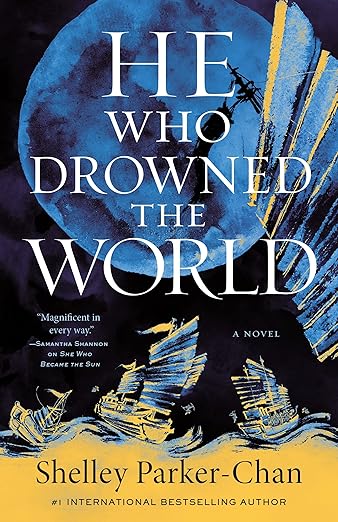
 This finale to Shelley Parker-Chan’s The Radiant Emperor Duology was outstanding. As with the first book (She Who Became the Sun), Parker-Chan focuses on the political and military machinations of a handful of ambitious individuals, each desperate for power and/or revenge. Parker-Chan has created complex characters who, despite their violent and frequently perverse proclivities, can also occasionally inspire pity. The court intrigues and double crossings had me on the edge of my seat, and the battles — sometimes featuring very hungry ghosts — were harrowing. He Who Drowned the World keeps a relentless pace and I hated to put it down BUT be warned: the story contains plenty of triggering subject matter including self harm, mutilation, sexual violence, and torture.
The Radiant Emperor Duology is an interesting mix of history and fantasy. The two books are set during the real fall of the Mongol/Yuan dynasty in China and the rise of the new Ming dynasty thanks to the efforts of rebels called the Red Turbans. Parker-Chan provides a vivid picture of what life at the royal court might have looked and felt like in the last days of foreign rule. The once mighty Yuan military is in some disarray due to both the rebels and battling factions within the court. The Emperor, aka the Great Khan, needs to sire more male heirs either by his wife the Empress or by one of his numerous concubines. His one male heir, known as the Third Prince, is the son of his favorite concubine but that heir’s position is precarious because he could easily be usurped by a male heir produced by the empress and the Great Khan dislikes him. At this court, the women close to the throne combat each other in secretive and ruthless ways, seeking powerful male allies (generals, ministers) in their quest to be the one who produces the next Emperor. While the Emperor is fighting to maintain his “Mandate of Heaven” to rule and battling the Red Turban rebels, other forces are rising against him as well, some of whom demonstrate signs of having the mandate, ie, the ability to produce flame from their hands and the ability to see ghosts.
The mandate seems to be a “will to power.” One does not demonstrate it simply because one is a biological heir to the throne. Several characters in this book have the mandate, most notably main character Zhu. Zhu was born a girl in unimaginable poverty. As an orphaned child, she determined that she would not be “nothing” as girls and women are usually fated to be. Instead she took on her dead brother’s identity and lived as a male. She entered a monastery and distinguished herself there before circumstances (General Ouyang) forced her out into the world. Convinced of her own inevitable success and of her fate to rule with the Mandate of Heaven, Zhu becomes the leader of the Red Turban rebels and is recognized as a legitimate threat to the Emperor. Others who have the mandate include a ruthless politician and general named Chen with whom Zhu was once allied; the Zhang brothers, who control the salt trade and have enormous economic and military power; and Wang Baoxiang. Baoxiang was adopted into a powerful Mongol family but never measured up to his father’s standards. He was not interested in or talented at being a warrior like his esteemed older brother Esen, but rather preferred the arts and what I would call land management. Baoxiang is very smart and quite talented at the boring side of ruling, but his jealousy of his brother, his resentment at not being loved or appreciated by those that mattered to him, turns him mean and dark. He always hated Ouyang, the eunuch general who was Esen’s best friend, and the feeling is mutual. Ouyang, meanwhile, carries a burden; his entire family was killed by the Great Khan for suspected treason but Ouyang was spared because he agreed to be made a eunuch. Ouyang has spent his life waiting to get his revenge. He is prepared to sacrifice everything and everyone to get it, but it takes a great toll on him.
Parker-Chan is masterful at telling these interwoven stories of intrigue. She moves deftly from one character’s piece of the story to another’s without confusing or boring the reader. Reading how the main characters plot against one another or form alliances was fascinating, and it helps that there are a lot of well drawn secondary characters who bring out the best or worst in everyone. One of the themes running through the duology has to do with why people are willing to go to such extreme lengths for power; are you doing it for yourself or for something bigger? All of the folks with the mandate seem to be of the opinion that might makes right, but Zhu, thanks to her bond with her “big brother” Xu Da and her wife Ma, starts to have qualms along the way and actually does go through some soul searching while on her quest. Another theme has to do with otherness, with being outside the norms of traditional society. Being female, a eunuch, gay, or having some physical deformity — all of these things make people “nothing” at best or somehow evil or tainted at worst. It was interesting to see how Parker-Chan had her characters with these “defects” react to that treatment. Internalize it? Fight against it? Believe it?
I highly recommend She Who Became the Sun and He Who Drowned the World. They are so well written, with great plots and characters. The trigger warning given above is no joke. There is some really disturbing stuff in here, but if you like history, thrillers, and intrigue, this duology hits all the marks.
