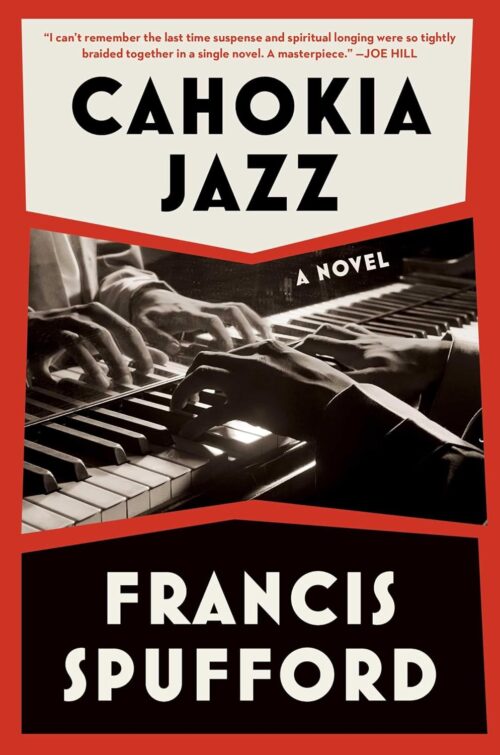
In Francis Spufford’s imaginative Cahokia Jazz, life in the United States in 1922 is not as we remember it from the history books. The “Cahokia” of the title refers to a state run largely by and for Native Americans, as a partial monarchy informed by Catholic teachings. As a thriving state, Cahokia is attracting more residents from outside the indigenous population, and relations are getting tense.
Detective Joe Barrow of the Cahokia P.D. is a man in the middle. A half-Black, half-native orphan from Nebraska, he is a man largely on his own in Cahokia, with the exception of his partner on the police force, Phin Drummond. Having met in the war, they share a bond that becomes strained when a bizarre, ritualized murder threatens to send Cahokia over the edge. A white man named Fred Hopper is murdered on the top of a government building in a manner reminiscent of Aztec human sacrifice, causing the white community to blame the Native population and make threats about taking power. The mayor and the police chief are breathing down Barrow and Drummond’s neck to get this solved fast.
Spufford deserves credit for the originality of his premise and the thoroughness of his world-building. He seems to have worked-out an extensive history of Cahokia as well as mapping out it’s political system, church life, business profile, and society. Unfortunately, all of this effort is being carried on the back of a protagonist who is thoroughly uninteresting, render much of the author’s work moot.
Part of the problem is that Spufford isn’t really interested in making the case or its investigation compelling. He purposely creates Barrow as an inexperienced policeman in order to allow him to blunder his way into various situations, each an excuse for Spufford to show off the world he has created. This has the side effect of slowing the pace of the plot down to a crawl. Cahokia Jazz is a slog at 450 pages. Though billed as a mystery in addition to its other genres, there aren’t a lot of suspects, clues, or other genre hallmarks for the reader to latch onto. Spufford is more interested in Barrow’s potential career in music. The “Jazz” in the title comes from Barrow’s sideline as a pianist, good enough to have offers to leave Cahokia and go on tour with the band. All of this has little to nothing to do with the murder investigation, which frankly caused me quite a lot of frustration.
The distinct impression left by Cahokia Jazz is that of a book written by an author not to entertain or even truly inform, but rather to cram in as much of the author’s research into the text. Even those with a keen interest in this kind of alternative-history will probably find Spufford’s lack of commitment to his story alienating.
