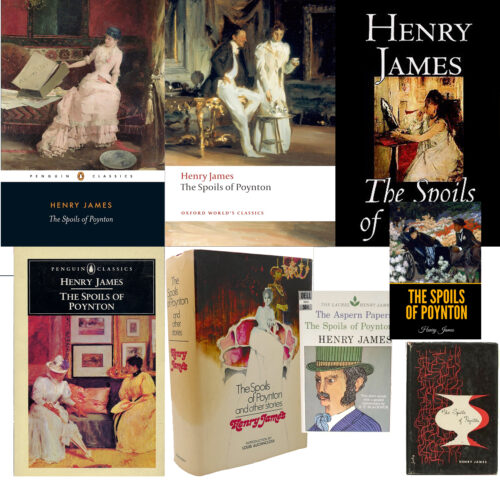
The Spoils of Poynton … should have been a short story rather than a novel. One can (almost) see the whole plot in the first few chapters. The simple set-up is this – Mrs. Gereth has lovingly and carefully collected art and antiques her entire adult married life with her husband. After his death it is discovered that Mr. Gereth has bequeathed the whole kit and caboodle, along with the stately home she has lived in her entire married life, to their only son Owen, on his marriage, which now appears to be imminent. Owen has recently fallen for Mona, a girl Mrs. Gereth can’t abide. Enter Fleda, who is crushing on Owen, who also has an appreciation of fine things. Mrs. Gereth would much prefer seeing Owen with Fleda, and then maybe she wouldn’t have to be completely kicked out of Poynton, or at least might have some visiting rights with all of her beloved art and antiques in the future.
The Spoils of Poynton’s characters seem more like they belong in an Oscar Wilde play than a James story – did he want to do his own (far less humorous) take on The Importance of Being Earnest? The back-and-forthing between the three main characters – Mrs. Gereth, Fleda and Owen – at times seems endless. The majority of the book is dialogue. It doesn’t help that none of these three are remotely likable, although I felt more sympathy towards the crafty and cranky Mrs. Gereth than James probably intended. I love objet d’art and “old things” (the original title of the book) and shared her outrage at being forced to hand it all over to her dopey son and acquisitive bride-to-be. Primogeniture (when the oldest son or male relative gets everything) was never fair or good for any women concerned.
Fleda Vetch – could Henry James have looked down upon his main character more? What sort of a crazy name is that? She is the main character of The Spoils of Poynton in the sense that she narrates the piece, but she is manipulated and influenced by everyone she speaks to – and also by her own twisted senses of duty and propriety. It is hard to root for her – should the reader hope that she and Owen eventually get together, or that Fleda gets away from this horrid family?
The one aspect of the book that worked well (and James is a master of) was the ambiguity of everyone’s position. Is Fleda really so noble (or naive), or does she harbor hopes of being the mistress of Poynton and all its wonderful stuff. Is Owen really just a blockhead, or is he willing and able to play emotional ping-pong between two girls in order to get all the treasures and Poynton, too. Is the (mostly offstage) Mona really such a Philistine or actually another Mrs. Gereth in training?
I promised no spoilers, but James does try to tie everything up with a bit of a twist at the end. I’m not sure that I can actually recommend that one should read this novel to find out what happens to the tepid love triangle, Mrs. Gereth, the “spoils,” etc … but if you enjoy James’s way with language and a small bunch of characters who never really say what they mean about a grand old British house full of supposed valuables, then give it a try. For me, as far as literary houses go, I’ll take Manderley over Poynton any day of the week.
[I read this book for my book group. I have read and enjoyed other works of James in the past (The Turn of the Screw, The Aspern Papers, short stories, etc.), but had not heard of this book before I read it. I listened to it on Audible. Juliet Stevenson gave a great performance of the three main characters in the novel.]