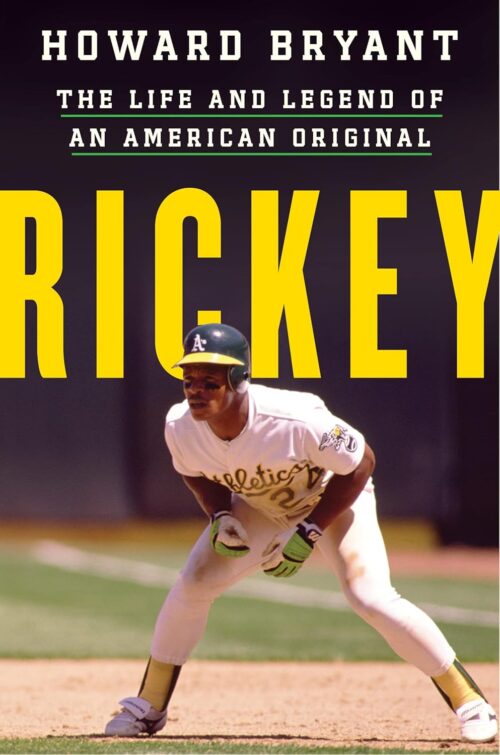
I like baseball and I like books, so it only stands to reason that I like books about baseball, too. But I do have reservations. I tend to prefer reading books about the game as a whole over a distinct period of time, or an account of one particular team or season. I’m less enamored of baseball player biographies, like Howard Bryant’s Rickey. They tend to fall into the trap of being repetitively structured, methodically going through a player’s career one season at a time, amounting to a book that can feel a little like someone reciting a list of statistics at you.
The problem is that most baseball players aren’t interesting enough off the diamond to really merit a lengthy biography, whatever their accomplishments on the field. For every Jackie Robinson or Roberto Clemente, who made impacts far beyond baseball, there are many more greats of the game who just showed up, put on the uniform and went to work. At first blush, Rickey Henderson might seem to offer more for a biographer to work with. Baseball fans the world over love to share stories of “Rickey being Rickey.” He was a colorful character who played the game with swagger that none could match. His records speak for themselves: Rickey is baseball’s all-time leader in stolen bases, unintentional walks, and runs scored. His stolen base records for both career and a single season will almost certainly never be surpassed. But he also was frequently a lightning rod for controversy. His celebrations lead to accusations of poor sportsmanship, and his singular focus on playing the game his way often soured into teammates accusing him of being selfish. For all his greatness, he was never popular in the press and was frequently traded because he’d worn out his welcome.
Sportswriter Howard Bryant chronicles these dustups with writers, team executives, and fellow players, often weighing in on Henderson’s side by taking a closer look at what the stats have to say. Bryant speaks with an insider’s knowledge of the way sportswriters, particularly white sportswriters, could be blatantly unfair towards a Black player, especially one who refused to play nice with them. He also brings in insight they may have lacked by going back to Rickey’s Oakland upbringing and lack of education. Much of Rickey’s wariness towards the press was rooted in fear that his speech would give away how much he struggled with the language.
The best part of the book is the beginning, where Bryant ties in Rickey’s youth with a remarkable era of Oakland athletic accomplishment. A staggering number of great athletes grew up in Oakland in the years during and just before Rickey’s youth, mainly a product of the Great Migration of African-American families away from the South, and congregating in West Oakland thanks to ingrained segregation.
Baseball fans will remember that Rickey’s career seemed never-ending. He held on into his forties, and never actually officially filed his retirement paperwork, convinced that he could still help a team with his superior speed, baserunning ability, and batting eye. In the back half of his career and in its aftermath, time caught up with Rickey Henderson. Young people who’d grown up watching Rickey loved to see him pick at his jersey during a home run trot or snatch a fly ball into his glove. They appreciated Rickey for who he was instead of trying to force him to be more like everybody else. Bryant’s biography, while perhaps not a classic baseball book, will nevertheless be a pleasant reminder for fans of how special Rickey’s game could be.
