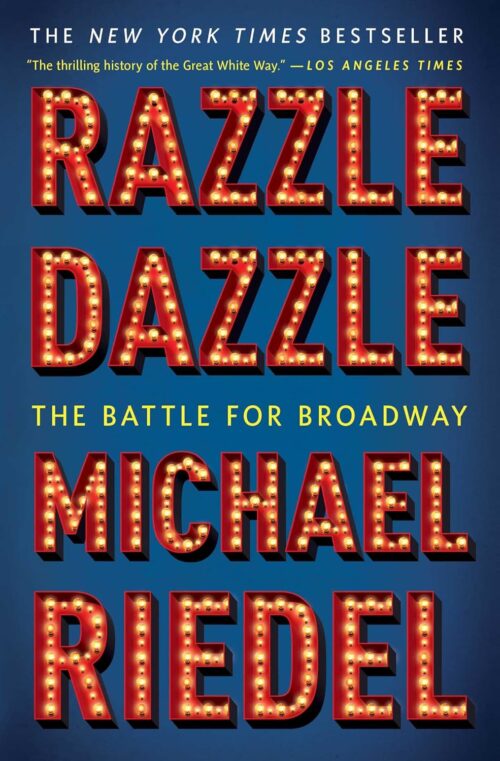
Fittingly for a book about Broadway, Razzle Dazzle takes a big swing. It’s an incredibly ambitious project, covering a wide span of territory, in time if not geography. Geographically, Riedel’s main focus is on a slice of West 44th Street known as Shubert Alley. That’s where the Shubert Organization, owners of seventeen Broadway theaters, conduct their business. Founded as a family business by Sam Shubert and his younger brothers Lee and J.J., the company had many up and down periods under their control, which formally ended with J.J.’s death in 1963. Even before then, though, a pair of company lawyers had begun setting in motion their consolidation of power within the Shubert Organization. These two men, Gerald Schoenfeld and Bernard Jacobs, are more or less the protagonists of Razzle Dazzle. They navigated the Shubert Organization, and in many ways, Broadway itself, through huge legal and financial challenges in the 1960s and ’70s, ruled over an extended period of peace between capital and labor, and, despite lacking a background in theater, developed genuine instincts for what shows the American public wanted to see.
Razzle Dazzle isn’t a biography of Schoenfeld and Jacobs, or of the Shubert organization itself, but their story is so central to the story of Broadway itself that it sometimes feels like it. Riedel does, however, expand his focus to cover those who collaborated or competed with the Shuberts. Theater owner Jimmy Nederlander, producer David Merrick, directors Bob Fosse, Tommy Tune, and especially A Chorus Line director Michael Bennett receive careful attention from Riedel. As time goes on, tastes change and new names come to the forefront, like Andrew Lloyd Webber, Cameron Mackintosh, and powerful New York Times critic Frank Rich, the Butcher of Broadway. Through it all, the Shubert Organization under Schoenfeld and Jacobs remains a steadying force, until time and tragedy start to take their toll in the Eighties. AIDS looms like a specter over the latter half of the book, until it emerges from the shadows and forever changes the trajectory of the American theater. Eventually, the age of Schoenfeld and Jacobs comes to a close, though the Shubert Organization and their seventeen theaters remain a staple of Broadway, Razzle Dazzle ends with the sense that things will never be the same.
Razzle Dazzle feels like a must-read for any Broadway superfan. Riedel manages to capture the wild, chaotic process by which both flops and hits are made in a way that’s almost as thrilling as being in the audience for a great 11-o’clock number.
