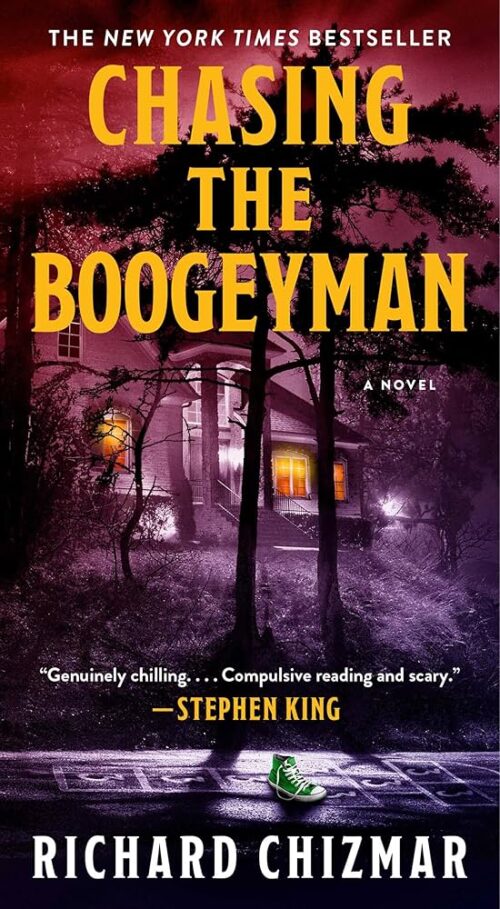
 In the summer of 1988 a serial killer began stalking the small town of Edgewood, Maryland. Young girls killed and mutilated, their bodies left on display, and zero evidence left behind by the killer. Richard Chizmar, a recent graduate from the University of Maryland, returns home in the middle of the spree just as a curfew has been enacted. As he prepares for his wedding and begins his writing career, he finds himself more entwined with the case than he would have thought possible. Between his (self-admitted) morbid need to drive past the crime scenes, and the late-night phone calls from a heavy breather, Richard begins to feel surrounded by the presence of the killer the news has dubbed “The Boogeyman”.
Chasing the Boogeyman is a fascinating experiment of a novel. It’s written in the style of a true crime nonfiction book, with photographs inserted at the end of every chapter of places and people relevant to the story. It’s also written very dryly, like someone doing their best to recall past events in great detail. A great deal of time (almost 70 pages of the book) is devoted to the town of Edgewood itself, the back roads and shortcuts, Chizmar’s childhood memories, and the history of the town and its demographics. It’s very Stephen King-like in its loving description of Edgewood, if Stephen King had frontloaded IT with all of Derry’s backstory. It is so convincingly written as nonfiction that I had to re-read the forward aloud to convince my book club that it was, in fact, a work of fiction. There was no serial killer in Edgewood, Maryland, and despite the wealth of details and photographs, the murders in the story never took place. Richard Chizmar is a real person (and the horror magazine he founded really does exist) but everything else was made up.
As for the story itself, it’s enjoyable. Chizmar does a good job centering the victims and their families, which many horror novels and true crime nonfiction books fail to do. A lot of time is devoted to the community’s reaction to the killings, and how fear and suspicion can cause even a tight-knit community to begin to turn on itself. Chasing the Boogeyman ends the 1988 storyline abruptly, and with no satisfying conclusion. The murders stop, but no suspect is ever identified. It’s not until years later that a detective working the cold case makes a connection that eventually leads to the killer. Some of the people in my book club hated that take, but it reminded me of I’ll be Gone in the Dark by Michelle McNamara, a nonfiction true crime book which was published posthumously and before the killer was caught. Honestly, it made me like Chasing the Boogeyman better.
There is a follow-up novel, Becoming the Boogeyman, which seems to be more of a straight-forward thriller? If anyone has read it, let me know if it’s worth the read!
