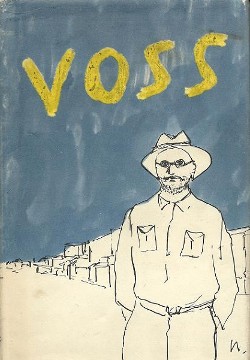
I have an embarrassing confession to make: I have never read anything written by Patrick White. It’s odd, and somewhat disappointing really, that our only Australian-born Nobel Laureate for literature is so frequently passed over. For example, I never heard his name brought up once when I was studying English. He doesn’t seem to have much of a profile outside of Australia either. (Unlike say, Gerald Murnane, who seems to be slightly more recognized here in the US than at home.)
So, I made the conscious effort to track down and read one of his most notable works—Voss.
Voss is inspired by the story of the Prussian explorer and naturalist Ludwig Leichhardt, who was famous for his expeditions to northern Australia, before disappearing in 1848 while trying to cross the country from east to west. With his grand ambitions and arrogant bent, Johann Ulrich Voss doesn’t fit well amongst Australia’s polite society. Invited to a gathering by his patron, Edmund Bonner, Voss makes a somewhat difficult to define connection with Bonner’s niece Laura Trevalyn. More intellectually minded than many of her peers and certainly more solitary and independent, Laura too, sees no need to tie herself into knots in order to fit into society. Although they only spend a week in each others company, they seem to recognize something of themselves in each other. Perhaps in another time or another place, they could have developed a proper romance, but knowing what we do of Voss’ historical counterpart, we know that’s not the path that’ll be taken. This is not a Jane Austin novel we are dealing with here.*
Once Voss’ expedition sets off proper, the book alternates between their two points of view. As Voss and this men start crossing pass the Hunter Valley, it becomes that clear that they physical and practically difficulties traversing the country are only one part of the challenge. It’s the psychological (and potentially, spiritual) hurdles that become the hardest to conquer. Voss comes to discover that he is not as super-human or as self sufficient as he once thought. Pure will is not enough, it seems, when crossing the interior. And Voss starts to break down.
Laura’s own challenges back in Sydney are, on the face of it, of a very different character. While never the best fit for polite society, Laura shatters any opportunity he had to integrate once she makes a very brave and heart felts decision to help a young pregnant woman in need. While Laura’s trials seem less ‘epic’ than those of Voss, she also suffers due to her determination to push ahead and do what she thinks is right—even if society has not caught up yet. Perhaps one day it will.
Like the two protagonists, most of the progress through Voss is more internally focused than external. Both Laura and Voss are extremely complex characters, and White spends a good deal of time taking us into their heads ands peeling them apart, layer by layer. While both Voss and Laura are separated by a great physical distance, one is always on the other’s mind as they share a common suffering. And when their written correspondence starts to break down—as we knew it would, as Voss and his expedition reach into the unknown—they start to connect with each other on the spiritual plane.
I strongly suspect that fact we spend so much time examining the internal states of Luara and Voss is one of the reasons that this book is not seen as approachable. Also, and I may be reaching out on a limb here, this book is positively steeped in religious symbolism, to a degree that most other Australian authors wouldn’t even come close to approaching. On top of this, White’s writing is incredibly dense and demanding; I was ‘reading’ Voss via audiobook, so I wasn’t doing the best job annotating various passages, but to give a few examples:
“She would have liked to sit upon a rock and listen to words, not of any man, but detached, mysterious, poetic words that she alone would interpret through some sense inherited from sleep.”
“It was the valley itself which drew Voss. Its mineral splendours were increased in that light. As bronze retreated, veins of silver loomed in the gullies, knobs of amethyst and sapphire glowed on the hills, until the horseman rounded that bastion which fortified from sight the ultimate stronghold of beauty.”
It’s very evocative and I think the effort is well and truly worth the reward, but Voss is not a book that is easily consumed. Even though I’ve gone through it once, I think it desires a re-read at some point so I can treat it with a little more attention and care.** This is a four and a half for me. I appreciate it for what it is, but I feel there should be still more I have to unwind.
But before I give the book another go? I might give The Vivisector a shot.
* I have to say I am not a fan of the blurb here: “Voss is the story of the secret passion between an explorer and a naïve young woman.” Not how I would describe their relationship—or the book as a whole—at all.
** I listened to latter half of the book while driving; I would not follow my example. Additionally, I feel that if you were signed this book to a Year 12 English class, the students might mutiny more than the expedition’s men…
